Rachel Lebowitz (dez. 2, 2016)
Desde o seu início no começo dos anos 1960, a pop art era um clube dos meninos. Grandes nomes como Andy Warhol e Tom Wesselmann perpetuaram o mito do (homem) artista-como-gênio. O movimento surgiu em meio às explosões do consumismo capitalista e da mídia de massa após a Segunda Guerra Mundial, enquanto os artistas exploravam novos modos de produção mecânica, muitas vezes utilizando bens de consumo comuns e ícones da cultura pop como tema. Associada a uma atitude desapegada e distante em relação à criação artística, as características codificadas da Pop Art são, por sua vez, estereotipicamente masculinas.
Para as artistas mulheres que participavam do movimento, cultivar uma persona de artista séria parecia ser a única maneira de obter sucesso. Uma estratégia alternativa era (muitas vezes de forma irreverente) criticar a Pop Art e seus mecanismos de dentro para fora. Em muitos casos, porém, essas estratégias foram interpretadas como uma forma de seguir as regras em vez de desafiá-las e, na maioria das vezes, esses caminhos não recompensaram as artistas mulheres com um lugar duradouro no mainstream. Agora, no entanto, com as nuances de suas práticas melhor compreendidas, artistas mulheres de todo o mundo estão ganhando mais reconhecimento por suas contribuições e desafios à Pop Art.
Associadas ao movimento Pop em diferentes graus, as seguintes 11 artistas mulheres (de forma alguma uma lista exaustiva) engajaram-se com suas motivações e características definidoras, algumas expandindo o gênero por meio de uma inflexão feminista, outras trabalhando em suas margens.
From its inception in the early 1960s, pop art was a boys´ club. Huge names like Andy Warhol and Tom Wesselmann perpetuated the myth of the (male) artist-as-genius. The movement emerged amid the post-World War II explosions of capitalist consumerism and mass media, as artists explored new modes of mechanical production, often by taking commonplace consumer goods and pop-cultural icons as their subject matter. Associated with an unemotional, distanced attitude toward artmaking, Pop Art’s codified characteristics are, in turn, stereotypically male.
For female artists participating in the movement, cultivating a persona as a so-called serious artist seemed like the only way to succeed. An alternative strategy was to (often cheekily) critique Pop Art and its workings from the inside out. In many cases, though, these strategies were interpreted as playing by the rules rather than challenging them, and, more often than not, these routes failed to reward female artists with a lasting place in the mainstream. Now, however, with the nuances of their practices better understood, female artists from around the globe are gaining more recognition for their contributions and challenges to Pop Art.
Associated with the Pop movement to varying extents, the following 11 women artists (by no means an exhaustive list) all engaged with its motivations and defining characteristics, some by expanding the genre through feminist inflection, others by working along its margins.
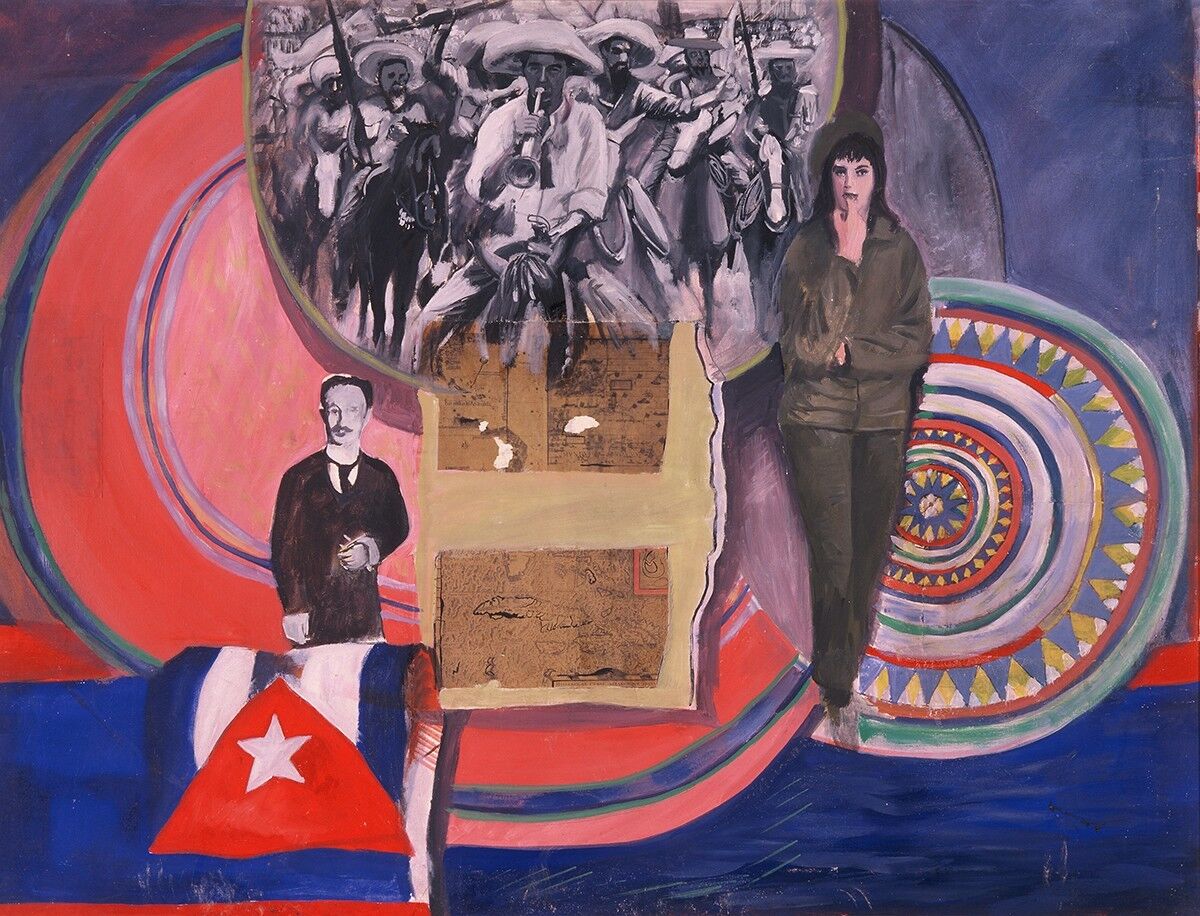
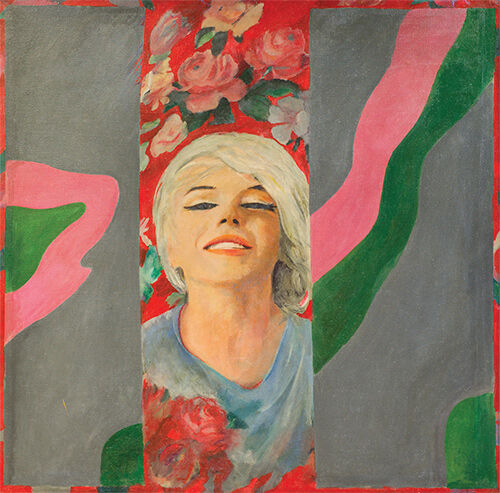
PAULINE BOTY
Pauline Boty, Cuba Si, 1963.
Private collection. Courtesy of Kunstmuseum Wolfsburg.
Pauline Boty, Colour Her Gone, 1962. Wolverhampton Arts & Museums Wolverhampton Art Gallery. Courtesy of Kunstmuseum Wolfsburg.
Uma fundadora, a única mulher, da Pop Art britânica, Pauline Boty, nascida em Londres, foi treinada em vitrais na Wimbledon School of Art e na Royal College of Art, embora também trabalhasse com pintura e colagem. Como também era uma atriz atraente, seu talento frequentemente foi subestimado. Nenhuma de suas obras foi exibida na Grã-Bretanha desde sua morte em 1966 (com apenas 28 anos) até 1993. Felizmente, nos últimos anos, uma série de exposições a tirou do esquecimento. Em 1962, Boty foi destaque ao lado de seus contemporâneos Peter Blake, Peter Phillips e Derek Boshier no documentário de Ken Russell, “Pop Goes the Easel”. Desorientador e experimental, o segmento de Boty se diferenciava dos de seus colegas homens, assim como sua prática artística. Ao contrário do distanciamento frio de um Warhol ou Roy Lichtenstein, as obras de Boty surgiam de um interesse engajado, referenciando temas políticos como a Crise dos Mísseis de Cuba. Em imagens vibrantes de figuras detalhadas sobre manchas expressionistas de cor, Boty também apresentava uma perspectiva sobre a experiência e a sexualidade feminina que retratava as mulheres como desejantes, e não apenas desejadas, com os homens também como objetos sexuais. “It’s a Man’s World I” (1964), por exemplo, é uma obra reflexiva que justapõe figuras masculinas, dos Beatles a Albert Einstein, com uma única rosa vermelha, um símbolo recorrente da sexualidade feminina para Boty.
A founder, the only female one, of British Pop, London-born Boty was trained in stained glass at the Wimbledon School of Art and the Royal College of Art, though she likewise worked in painting and collage. As she was also an attractive actress, her talent has often been overlooked. None of her works were shown in Britain from her death in 1966 (at just 28) until 1993. Fortunately, over the past few years, a number of exhibitions have brought her out of obscurity. In the 1962, Boty was featured with her contemporaries Peter Blake, Peter Philips and Derek Boshier, in Ken Russell’s documentary Pop Goes the Easel. Disorienting and experimental, Boty’s segment departed from those of her male compatriots, as did her practice. Rather than the cool detachment of a Warhol or Roy Lichtenstein. Boty’s works sprang from involved interest, referencing political subjects like the Cuban Missile Crisis. In vibrant images of detailed figures against expressionistic swaths of color, Boty also presented a perspective on female experience and sexuality that presented women as desiring, rather than just desired, with men as sex objects, too. “It’s a Man’s World I” (1964), for instance, is a reflective work that juxtaposes male figures from the Beatles to Albert Einstein with a single red rose, a recurring symbol of female sexuality for Boty.
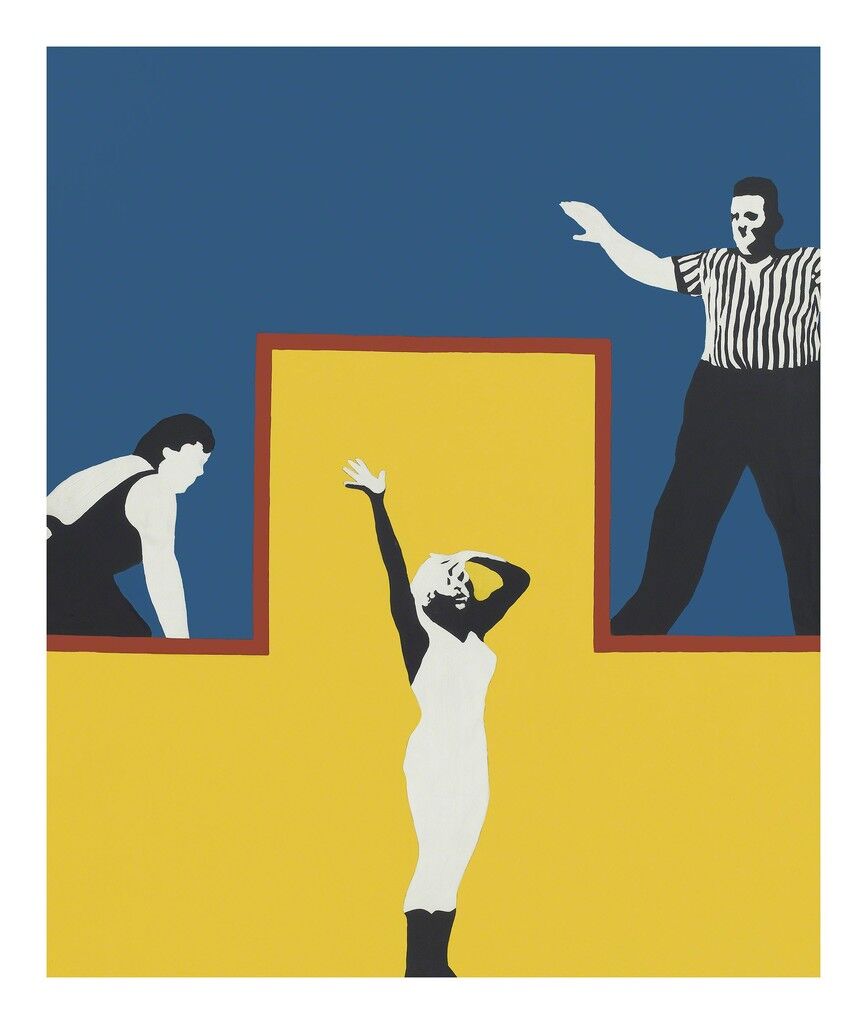
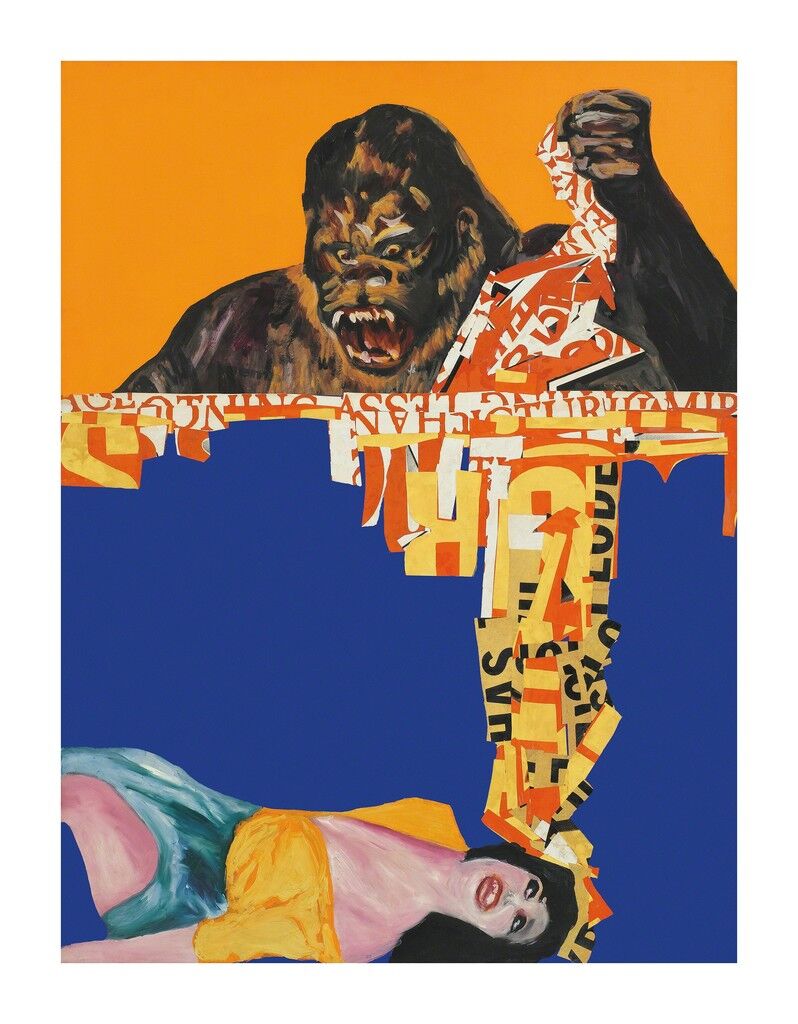
ROSALYN DREXLER
Rosalyn Drexler
The winner, 1965
Garth Greenan Gallery
Rosalyn Drexler
The dream, 1963
Garth Greenan Gallery
Drexler descreveu as narrativas não declaradas em seu trabalho como “um tipo de música”. No entanto, suas colagens ousadas de tinta e papel com blocos de cores sobre tela parecem cenas de filme achatadas, com referências claras a gângsteres, King Kong e Marilyn Monroe. Em 1964, ela foi incluída, assim como Strider na “Primeira Exposição Internacional Girlie” (First International Girlie Show) na Pace Gallery, ao lado de Warhol, Wesselmann e Lichtenstein. Ainda assim, ela não era bem conhecida naquela década e se considerava principalmente uma escritora, especialmente ao comparar seu trabalho e carreira com os de seus amigos Franz Kline e Willem e Elaine de Kooning.
Além de escrever, ela recebeu três prêmios Obie por suas peças teatrais, Drexler foi uma lutadora profissional de wrestling, algo que talvez se reflita em sua obra “The Winner” (1965). Pintando sobre fotografias encontradas e coladas, ela injeta uma narrativa pessoal e deixa vestígios do processo criativo, complicando a produção mecanizada tipicamente associada à Pop Art.
Drexler has described the unstated narratives in her work as “a kind of music.” Yet her bold, color-block paint-and-paper collages on canvas read like flattened film scenes, with distinct references to gangsters, King Kong, and Marilyn Monroe. In 1964, she was included as was Strider in the “First International Girlie Show” at Pace Gallery, along with Warhol, Wesselmann, and Lichtenstein. Still, she wasn’t well known in that decade, and she thought of herself mainly as a writer, especially when comparing her work and career with those of her friends Franz kline and Willem and Elaine de Kooning
In addition to writing, she holds three Obie Awards for playwriting, Drexler was a professional wrestler, perhaps reflected in her piece The Winner (1965). Painting over collaged found photographs, she injects a personal narrative and leaves traces of the creative process, complicating the mechanized production typically associated with Pop.
STURTEVANT
Sturtevant
Peintre à Haute Tension (Matial Rayse), 1970
Galerie Hans Mayer
Sturtevant
Harring Untitled, 1986
Anthony Reynolds Gallery
“Eu crio vertigem”, disse Elaine Sturtevant sobre sua obra que induz a uma segunda olhada. Trabalhando apenas com seu sobrenome de casada, Sturtevant executou “repetições” quase idênticas de obras de artistas homens, de Marcel Duchamp a Keith Haring, uma prática considerada por alguns como arte de apropriação, “avant la lettre”. Enquanto Warhol aprovava seus objetivos e lhe deu uma de suas telas originais de serigrafia para trabalhar, Oldenburg ficou perturbado com sua cópia de sua obra “The Store” (1961–64). Embora muitas vezes sutis, as distinções entre as obras originais e as criações de Sturtevant são intencionais. Ela se baseou em peças canônicas da Pop Art, mas suas obras eram feitas à mão, pintadas em vez de impressas em massa, e exploravam a própria criação artística como uma forma de transformação. Ela também investigou noções do (homem) artista-herói, originalidade, autenticidade e autoria, o que a diferenciou, mas também a tornou inseparável do movimento Pop.
Quando o favor do mundo da arte começou a escapar dela, Sturtevant se afastou por uma década, retornando eventualmente em meados dos anos 80. Mais tarde, no início do século XXI, ela se voltou para a arte em vídeo. Em 2011, foi premiada com um Leão de Ouro por sua contribuição vitalícia na Bienal de Veneza.
“I create vertigo,” Elaine Sturtevant said of her double take–inducing oeuvre. Working under only her marital last name, Sturtevant executed near-carbon-copy “repetitions” of works by male artists, from Marcel Duchamp to Keith Haring, a practice considered by some to be appropriation art, avant la lettre. While Warhol approved of her aims and gave her one of his original silkscreens to work from, Oldenburg was vexed by her copy of his work The Store (1961–64). Though often subtle, the distinctions between the original works and Sturtevant’s creations are by design. She drew on canonical Pop pieces, yet her works were handmade, painted rather than mass-printed, and they explored artmaking itself as a kind of transformation. She also investigated notions of the (male) artist-hero and originality, authenticity, and authorship, setting her apart but also rendering her inseparable from the Pop movement.
When art-world favor started to evade her, Sturtevant dropped out for a decade, eventually returning in the mid-’80s. Later, at the start of the 21st century, she turned to video art. In 2011, she was awarded a Golden Lion for Lifetime Achievement at the Venice Biennale.
SISTER MARY CORITA KENT
Corita kent
Peace bread, 1964
Corita Kent
News of the week, 1969
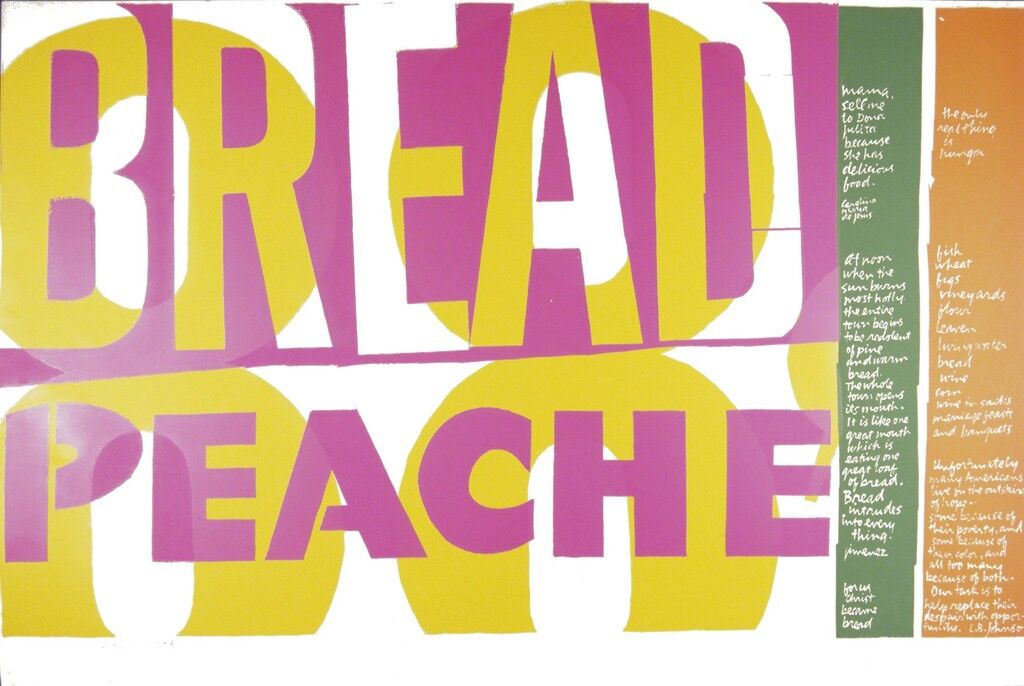
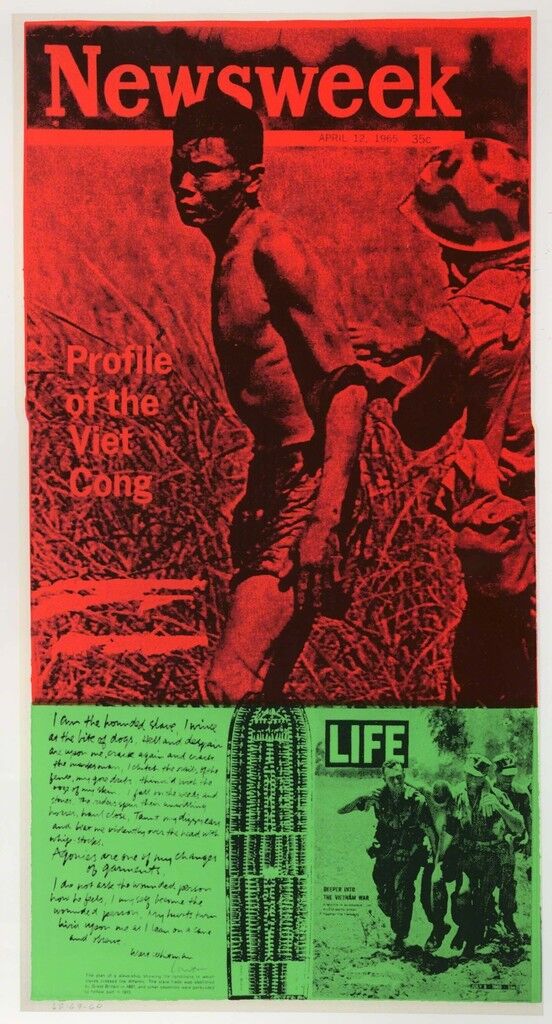
Às vezes conhecida como Irmã Mary Corita Kent, Kent era uma freira católica e professora de arte no Immaculate Heart College, em Los Angeles. Sua saída da escola (e da ordem religiosa) em 1968 estava parcialmente relacionada às tensões entre a ordem e a igreja devido às reformas progressistas do movimento Vaticano II, mas também coincidiu com seus próprios compromissos artísticos e sua crescente fama. Ao longo dos anos 60, ela fez aparições em rádio e TV e deu palestras por todo o EUA. Antes de Warhol tornar o meio famoso, ela já trabalhava com serigrafia (impressão em tela), pois podia ser produzida em massa de forma barata e amplamente disseminada. Suas obras vibrantes e coloridas comunicam-se por meio de uma simplicidade gráfica, combinando versículos da Bíblia, logotipos de marcas, citações literárias e até letras dos Beatles para explorar questões maiores, como pobreza, direitos civis e a Guerra do Vietnã, com o objetivo final de promover mudanças. Profundamente engajada com seus temas, ela permaneceu uma ativista até sua morte em 1986, ganhando o apelido de “a revolucionária alegre” do fotógrafo Ben Shahn.
Sometimes known as Sister Mary Corita Kent, Kent was a nun and art teacher at Immaculate Heart College in Los Angeles. Her departure from the school (and the order) in 1968 was partially related to tension between the order and the church over the progressive reforms of the Vatican II movement, but it was also timed with her own artistic commitments and rising renown. Throughout the ’60s, she made radio and TV appearances and lectured around the country. Before Warhol made the medium famous, she was working in serigraphy (screen-printing) because it could be cheaply mass-produced and widely disseminated. Her lively, colorful works speak through graphic simplicity as they combine Bible verses, brand logos, literary quotes, and even Beatles lyrics to explore larger issues like poverty, civil rights, and the Vietnam War, ultimately to effect change. Deeply engaged with her subject matter, she remained an activist up until her death in 1986, earning the moniker “the joyous revolutionary” from photographer Ben Shahn.
EVELYNE AXEL
Evelyne Axell
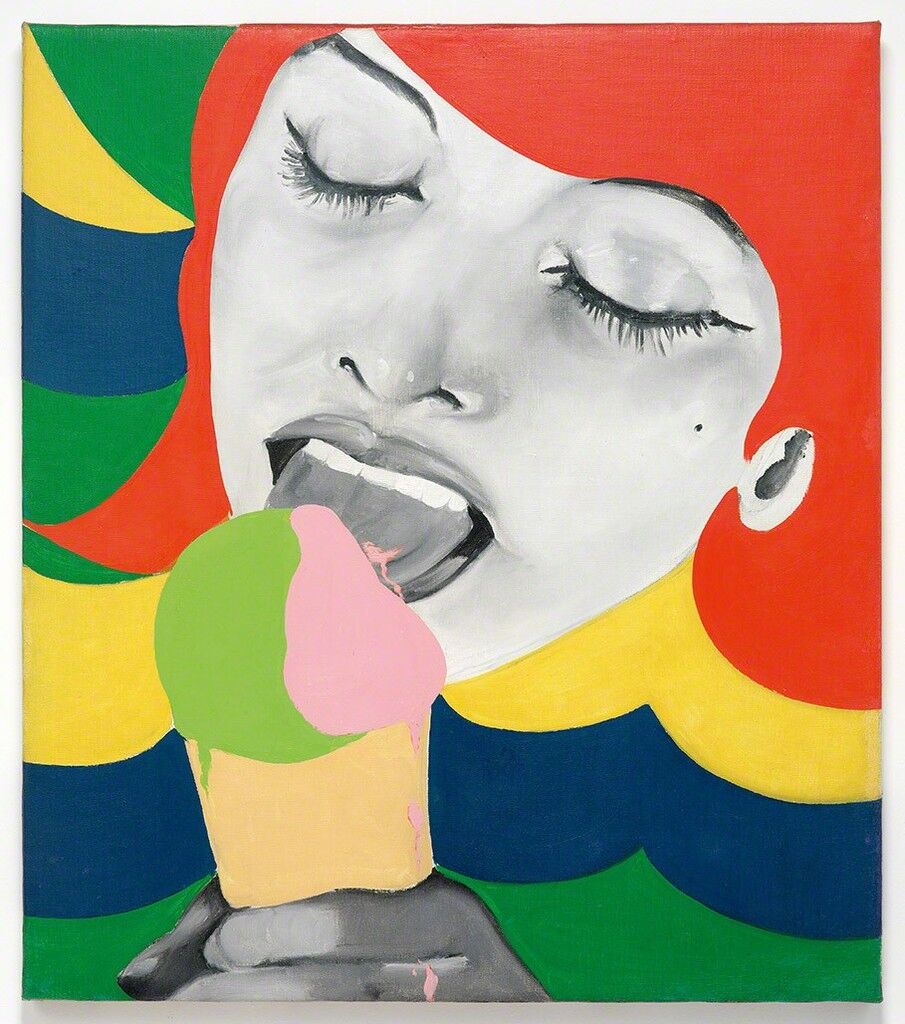
Ice cream, 1964
Walker Art Cernter
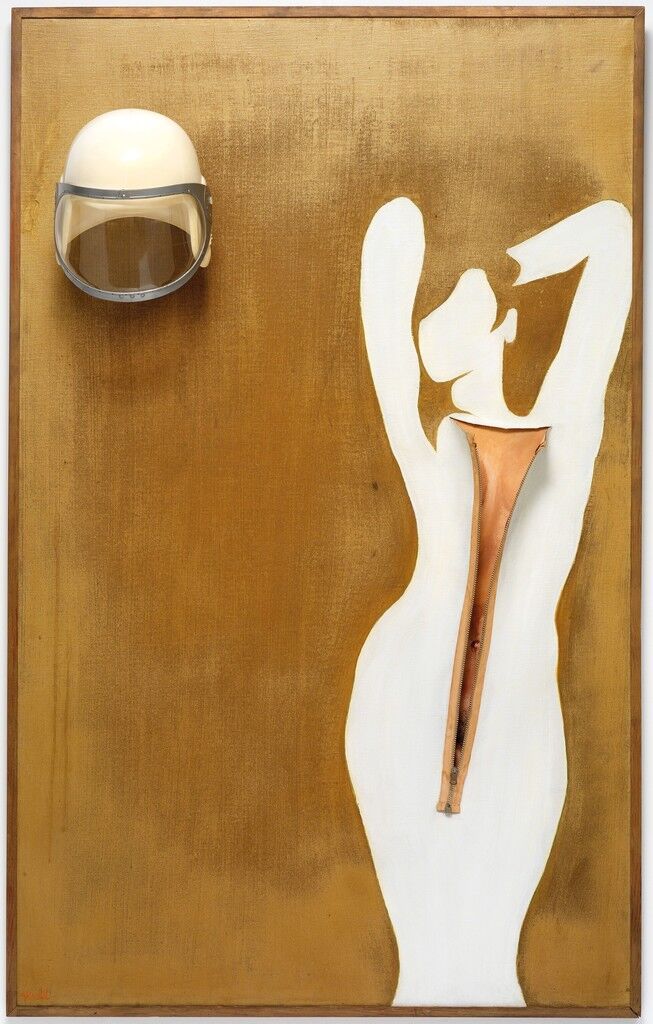
Evelyne Axell. Valentine, 1966
"The EY exhibition: The world goes pop" at the Modern, london
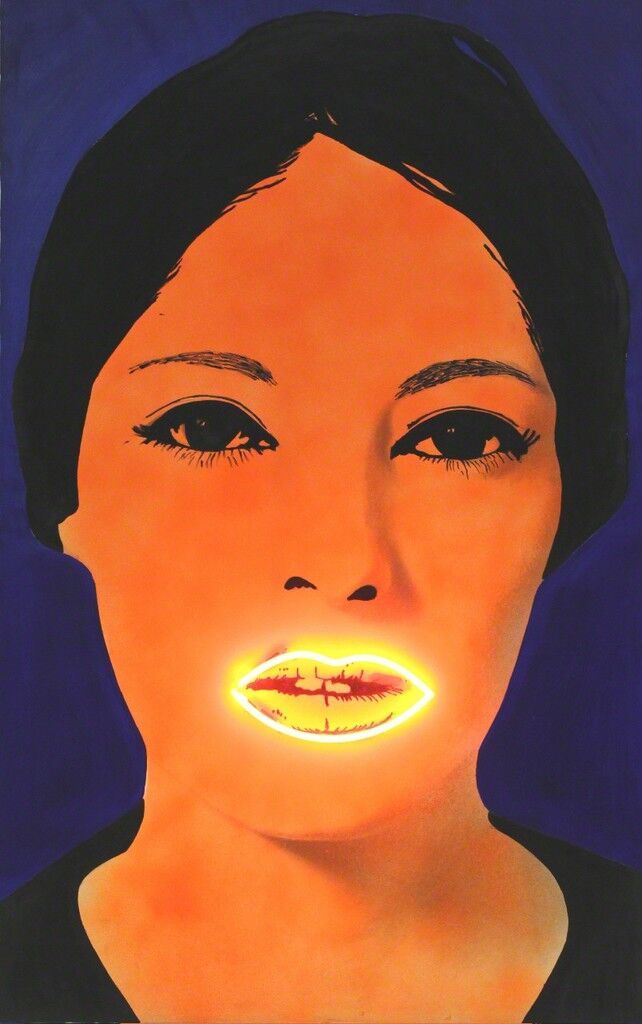
A artista belga Axell foi recentemente incluída nas exposições de museus “International Pop”, que passou por Minneapolis, Dallas e Filadélfia, e “The World Goes Pop” na Tate Modern. Na verdade, no verão passado (2015), sua obra “Valentine” (1966) garantiu a ela um lugar como a primeira artista mulher da Pop Art a ser incluída na coleção permanente da Tate Modern. A obra retrata uma cosmonauta feminina com um capacete de brinquedo (um capacete real, anteriormente usado pelo filho de Axell) e faz referência a Valentina Tereshkova, a primeira mulher a viajar para o espaço. Como uma nudez clássica encontrando uma pin-up à la Monroe, o corpo da mulher apresenta um zíper funcional que revela sua figura. Não apenas um objeto de desejo masculino, ela é dona de si, parecendo extrair empoderamento de sua profissão tradicionalmente masculina.
Outra obra, “Ice Cream” (1964), causou polêmica após ser censurada na página do Facebook do Museu de Arte da Filadélfia no início deste ano. Quando criada, foi mal interpretada como uma conformidade com o status quo. Agora, no entanto, é vista como uma expressão de libertação sexual e prazer feminino, opondo-se às figuras femininas meramente ornamentais que dominavam o movimento da Pop Art centrado nos homens.
Belgian artist Axell was recently included in the museum shows"Intenational Pop" which toured Minneapolis, Dallas, and Philadelphia, and "The wrold goes Pop" at the Tate Modern. In fact, this past summer, her work Valentine (1966) earned her a spot as the first female Pop artist to be included in the Tate Modern’s permanent collection. The work depicts a female cosmonaut with a toy helmet (a real helmet, formerly donned by Axell’s son) and references Valentina Tereshkova, the first woman to fly into space. Like a classical nude meeting a Monroe-esque pin-up, the woman’s body features a functioning zipper that reveals her figure. Not just an object of male desire, she is self-possessed, seeming to draw empowerment from her traditionally masculine profession.
Another piece, Ice Cream (1964), caused a stir after it was censored on the Philadelphia Museum of Art’s Facebook page earlier this year. When created, it was misunderstood as playing into the status quo. Now, however, it is seen as an expression of sexual liberation and female pleasure, standing in opposition to the merely ornamental female figures that dominated the male-centric Pop Art movement.
MARTA MINUJIN
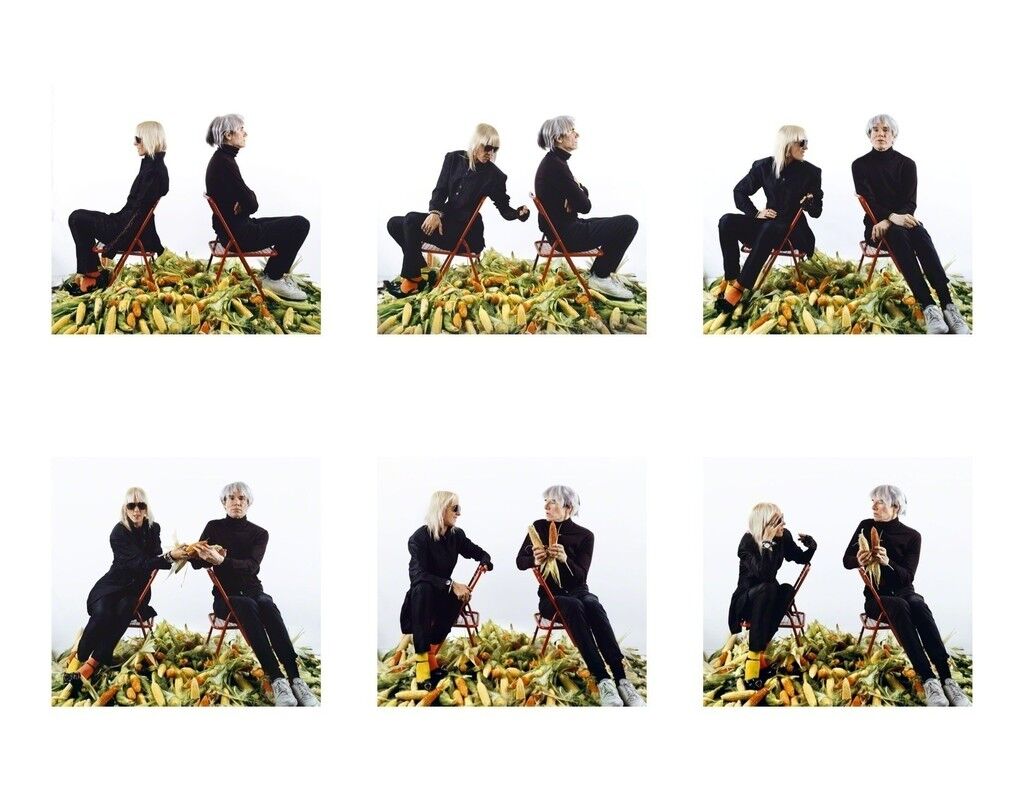
Marta Minujin. Oayment of the Argentine Forein Debt to Andy Warhol with corn, The Latin Aamericam Gold, 1985/2011.
Henrique Faria Fine Art.
Após se mudar para Nova York, a artista argentina Minujin tornou-se amiga de Warhol, a quem mais tarde incluiu em sua performance político-econômica “Paying off the Argentine Foreign Debt with Corn”, “the Latin American Gold” (1985/2011). Como Warhol, Minujin investigou a cultura do consumo, mas sua prática estava longe das obras higienizadas e produzidas em massa dele, que mantinham os espectadores à distância. Em vez disso, Minujin trabalhou contra o consumo historicamente passivo da arte e a crescente influência das novas formas de mídia de massa. Ela criou Happenings e ambientes experienciais (muitas vezes incorporando cores neon e fluorescentes) que transitavam entre a Pop Art e a arte conceitual participativa.
Talvez as obras mais influenciadas pela Pop Art sejam suas esculturas interativas de colchões pintados, que evocam (e convidam) à atividade sexual enquanto fazem referência a embalagens de produtos e ao consumismo por meio de suas cores geométricas vibrantes. Enquanto isso, em sua conhecida “Minuphone” (1967), um espectador discava um telefone em uma cabine telefônica que emitia várias cores e sons enquanto seu rosto aparecia em uma tela de televisão, transformando corpos humanos em formas mediadas.
After moving to New York, Argentine artist Minujin became friends with Warhol, whom she later featured in her politico-economic performance piece Paying off the Argentine Foreign Debt with Corn, “the Latin American Gold” (1985/2011). Like Warhol, Minujin investigated consumer culture, but her practice was a far cry from his sanitized, mass-produced works that held viewers at a remove. Instead, Minujin worked against the historically passive consumption of art and the increasing influence of new mass-media forms. She created Happenings and experiential environments (often incorporating neon and day-glo colors) that straddled the border between Pop and participatory, conceptual art.
Perhaps the most Pop-inflected of her works are her interactive painted mattress sculptures, which invoke (and invite) sexual activity while referencing product packaging and consumerism through their bright, geometric colors. Meanwhile, for her well-known Minuphone (1967), a viewer dialed a phone in a telephone booth that emitted various colors and sounds as his or her face appeared on a television screen, translating human bodies into mediated forms.
DOROTHY GREBENAK
Dorothy Grebenak
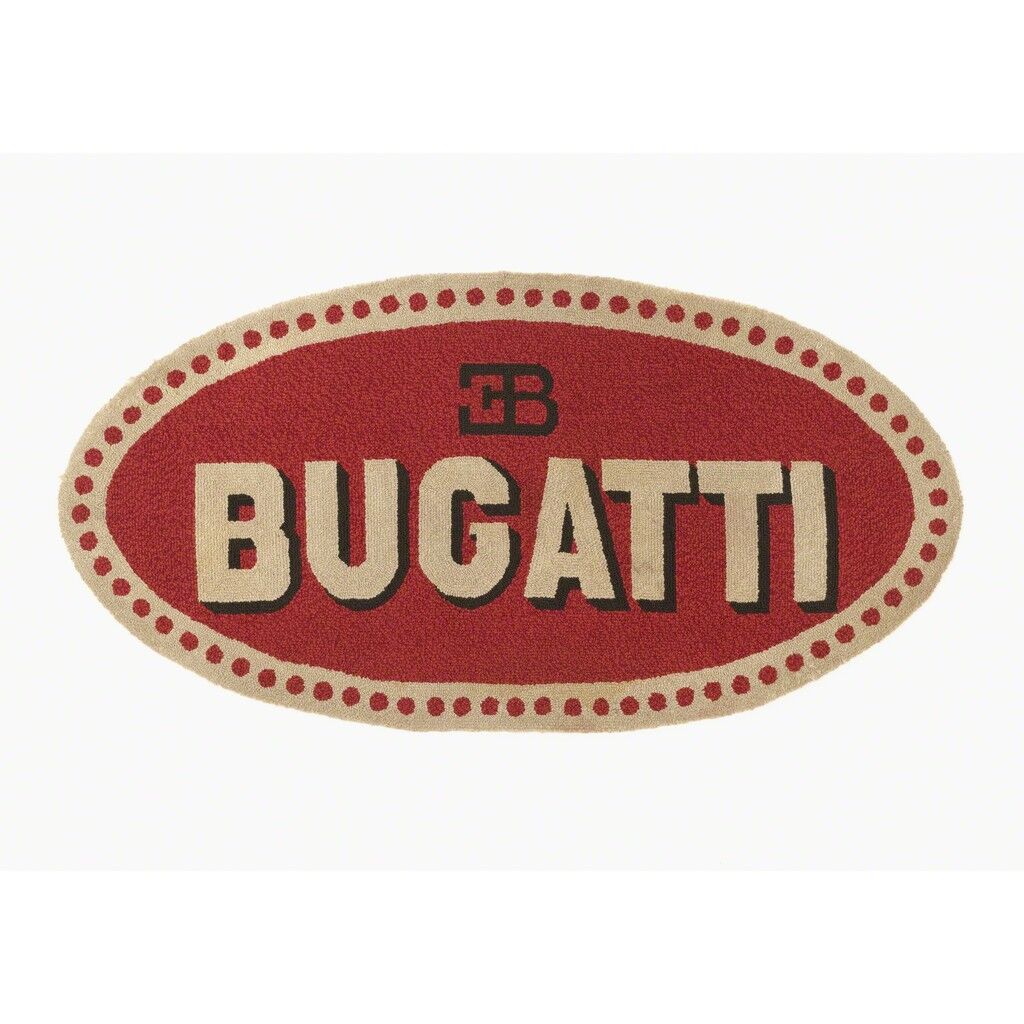
Bugatti, 1964
Allan Stone Projects
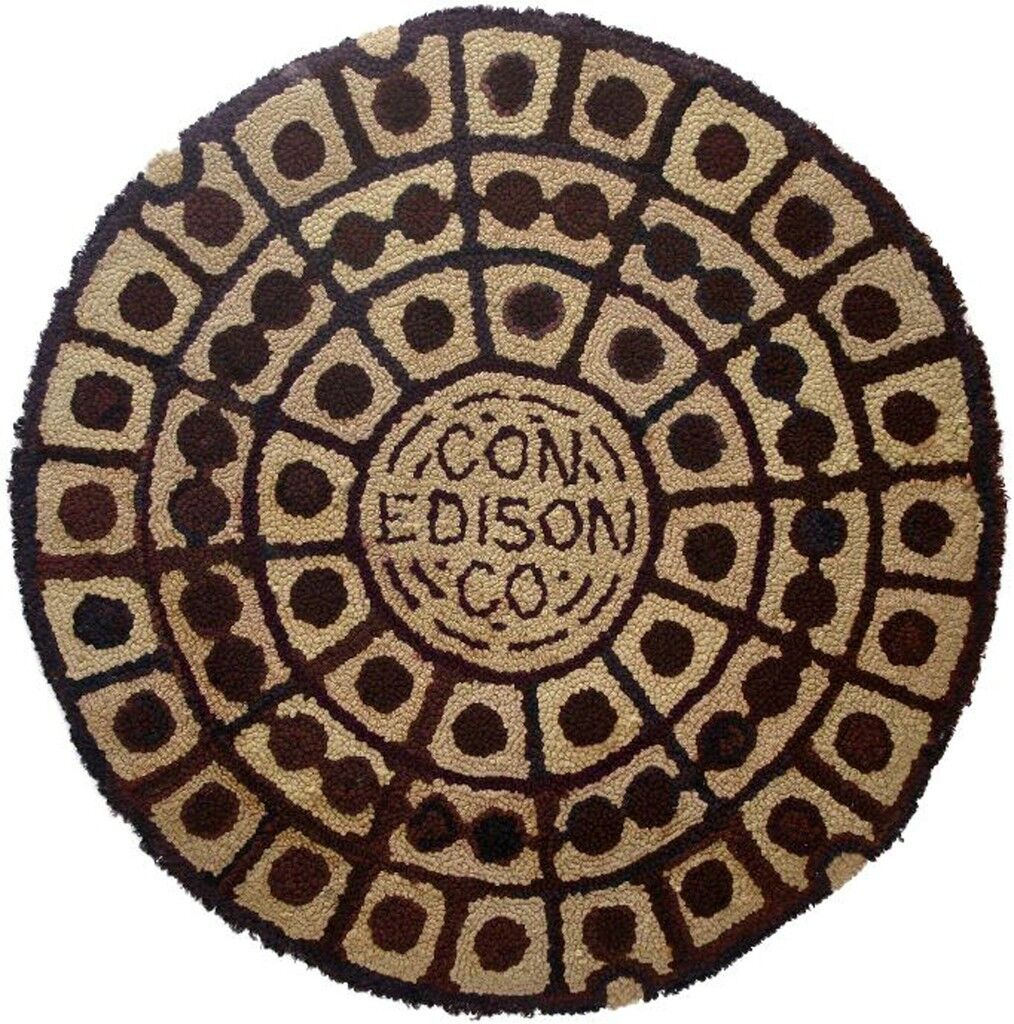
Dorothy Grebenak. Con Edison Co., ca. 1964.
Allan Stone Projects
Utilizando imagens emprestadas de Warhol e Lichtenstein para criar tapetes feitos à mão, a artista autodidata Grebenak explorou os limites entre arte e artesanato. Na verdade, antes de entrar no espaço da galeria, suas obras foram primeiro colocadas à venda na loja de presentes do Museu do Brooklyn. Incorporando logotipos de marcas que iam da Con Edison à Bugatti (seu galerista, Allan Stone, colecionava carros de luxo), Grebenak fundiu culturas populares e de consumo com a arte folclórica americana, além de elementos pessoais com os genéricos. Suas obras únicas contrastam com os produtos elegantes e onipresentes que referenciam, sem mencionar a arte mecanizada e fabricada que os grandes nomes masculinos da Pop Art estavam criando na época.
Borrowing imagery from Warhol and Lichtenstein to create handmade rugs, self-taught artist Grebenak explored the boundaries between fine art and craft. Indeed, before entering the gallery space, her works were first for sale in the gift shop of the Brooklyn Museum. Incorporating logos of brands ranging from Con Edison to Bugatti (her dealer, Allan stone, collected the luxury cars), Grebenak melded popular and consumer cultures with American folk art, as well as elements of the personal with the generic. Her one-of-a-kind works stand in contrast to the sleek, ubiquitous products they reference, not to mention the mechanized, manufactured art the male titans of Pop were creating at the time.
MARISOL
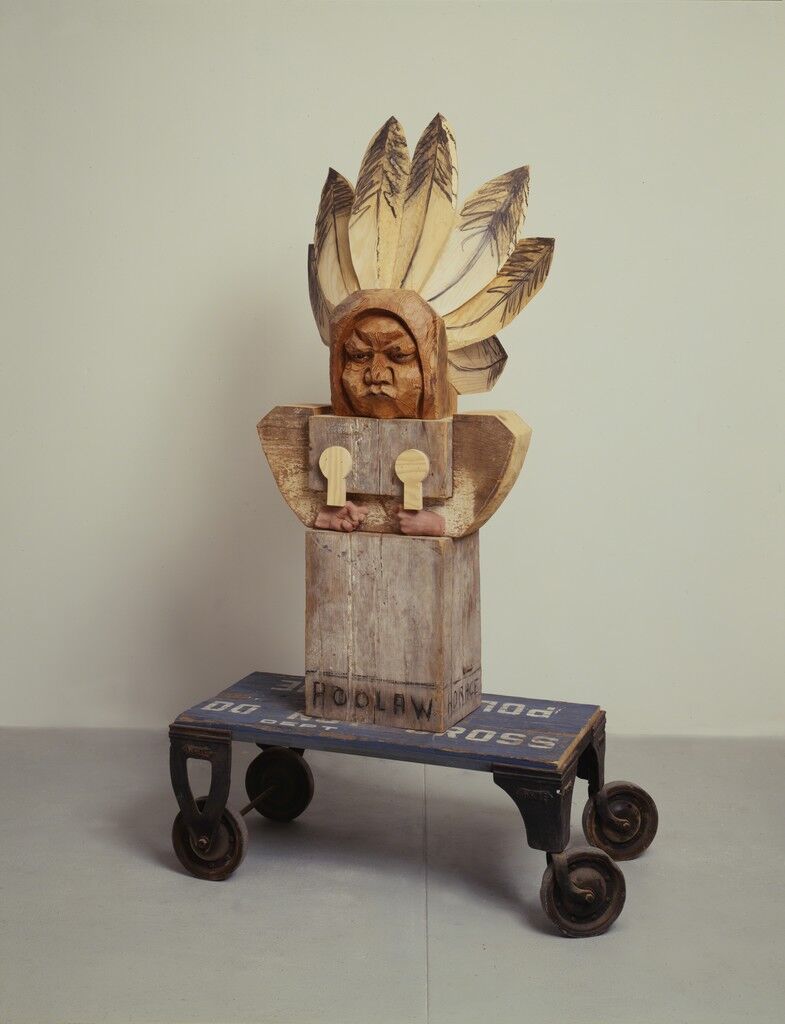
Marisol. Horace Poolaw, 1993.
El museo del barrio.
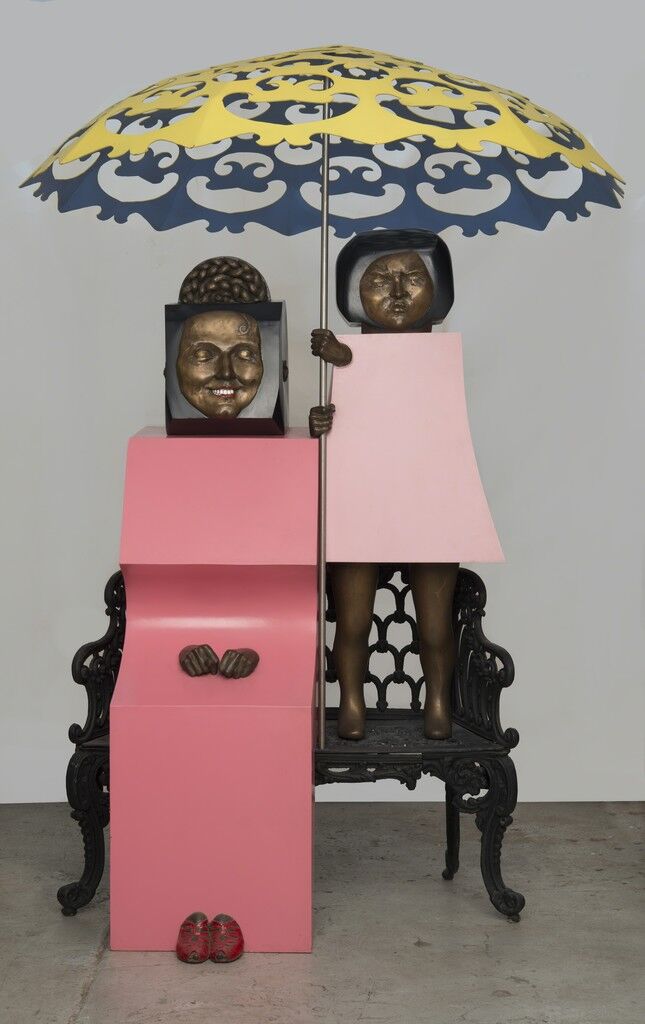
Marisol. Mi mama y Yo, 1968.
El Museo del Barrio.
Em sua juventude, a artista venezuelana nascida em Paris, Marisol (nascida Maria Sol Escobar), mudou-se para a cidade de Nova York, onde desenvolveu uma amizade com Warhol, chegando a aparecer em dois de seus filmes. Por um tempo, ela foi indiscutivelmente tão famosa quanto o próprio Warhol, expondo na Bienal de Veneza e na Documenta em 1968. No entanto, ela evitava os holofotes. Sua primeira exposição individual em um museu de Nova York, “Marisol: Sculpture and Works on Paper”, no Museo del Barrio em 2014, reacendeu o interesse recente por seu trabalho. Formada em expressionismo abstrato com Hans Hofmann em Nova York, ela mudou sua prática no início dos anos 50 para incorporar uma combinação de influências folclóricas pré-colombianas e assemblages à la Rauschenberg, em parte como uma resposta ao suicídio de sua mãe. Suas esculturas de madeira em tamanho real vão além dos limites da Pop Art, e ela hesitava em se associar ao movimento. Humorísticas, mas ao mesmo tempo inquietantes, suas obras incorporam objetos encontrados e retratam celebridades da época, desde os Kennedys até Bob Hope, além de grupos marginalizados e até mesmo sua própria família.
In her youth, Paris-born Venezuelan artist Marisol (born Maria Sol Escobar) moved to New York City, where she developed a friendship with Warhol, even featuring in two of his films. For a spell, she was arguably as famous as Warhol himself, showing at both the Venice Biennale and Documenta in 1968. Yet she eschewed the spotlight. Her first New York museum solo show, "Marisol: Sculptu and works on paper, at Museo del Barrio in 2014. Recently reignited interest in her work. Trained in abstract expressionim under Hans Hofmann in New York, she shifted her practice in the early ’50s to incorporate a combination of pre-Columbian folk influences and Raushcenberg-esque assemblage, in part, as a response to her mother’s suicide. Her life-size wooden sculptures step beyond the boundaries of Pop, and she was hesitant to associate herself with the movement. Humorous yet eerie, her works incorporate found objects and depict celebrities of the era, from the Kennedys to Bob Hope, as well as marginalized groups and even her own family.
MARJORIE STRIDER
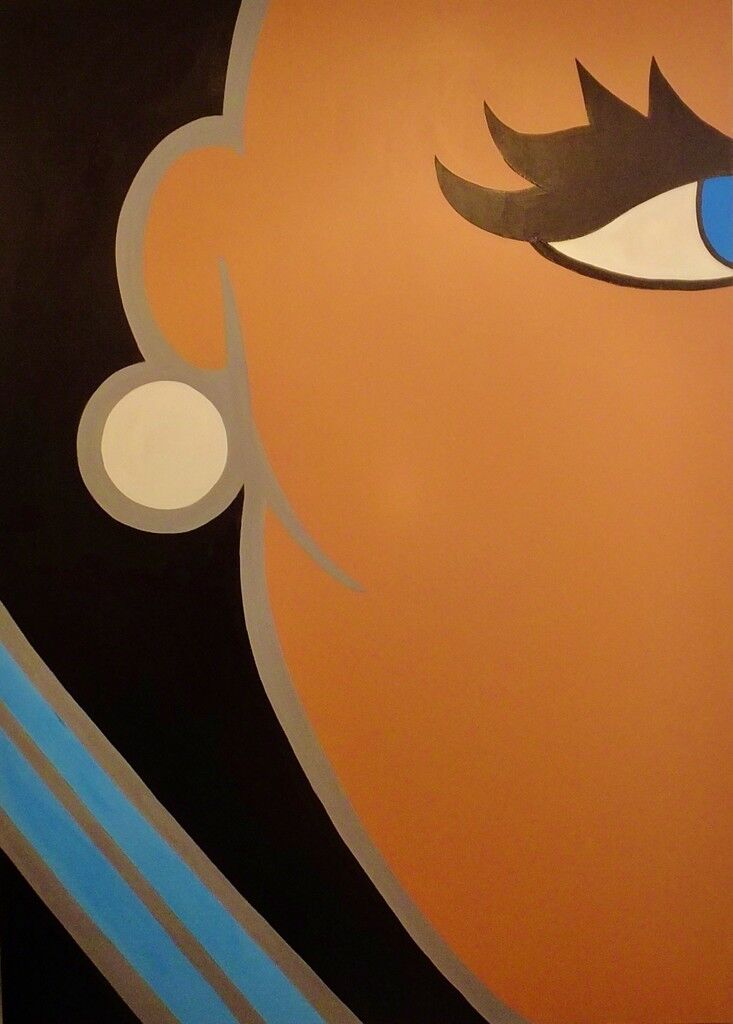
Marjorie Strider. The Girl with the pearl earningus, 2020. Laurence Fine Art.
Marjorie Strider. Bond Girl, ?
Joane Artman Galery.
A prática de pintura escultórica de Strider satiriza revistas masculinas. “Girl with Radish” (1963) exemplifica a combinação de humor e conteúdo desafiador que caracteriza suas obras. A peça apresenta um close-up de uma figura feminina genérica e estilizada, facilmente extraída de qualquer anúncio ou história em quadrinhos, que subverte a coquete sexualizada de boca aberta convencional ao segurar um rabanete entre os dentes. O rabanete é um dos “build-outs” característicos de Strider, os elementos tridimensionais que ela adicionava às superfícies de suas pinturas, que retratam desde vegetais comprados em lojas até pin-ups. Especialmente neste último caso, ela enfatizava aspectos da forma feminina tipicamente sujeitos ao olhar masculino, para que seu trabalho pudesse expor e desestabilizá-lo.
A prática de Strider estava em constante mudança estilística. Em 1969, ela ajudou a organizar “Street Works”, uma série de performances públicas de vários meses que incluía contribuições de Adrian Piper, Vito Acconci e da própria Strider. Nos anos 70, ela criou instalações maciças de escultura macia com espuma de poliuretano e, nas décadas seguintes, voltou a retratar figuras femininas, explorando sua abstração em traços lineares contra fundos estilizados e coloridos como arco-íris.
Strider’s sculptural painting practice satirizes men’s magazines. Girl with Radish (1963) exemplifies the combination of humor and challenging content that characterizes her works. The piece features a close-up of a generic, stylized female—easily plucked from any ad or comic strip—who upends the conventional open-mouthed, sexualized coquette by holding a radish between her teeth. The radish is one of Strider’s signature “build-outs,” the 3D elements she added to the surfaces of her paintings, which depict everything from store-bought vegetables to pin-up girls. Particularly in the latter case, she emphasized aspects of the female form typically subject to the male gaze so that her work could expose and destabilize it.
Strider’s practice was in continual stylistic flux. In 1969, she helped organize “Street Works,” a months-long public performance series that included contributions from Adrian Piper, Vito Acconci, and Strider herself. In the ’70s, she created massive soft-sculpture installations out of urethane foam, and, in later decades, she returned to depicting female figures, exploring their line-drawn abstraction against stylized, rainbow-colored backgrounds.
IDELLE WEBER
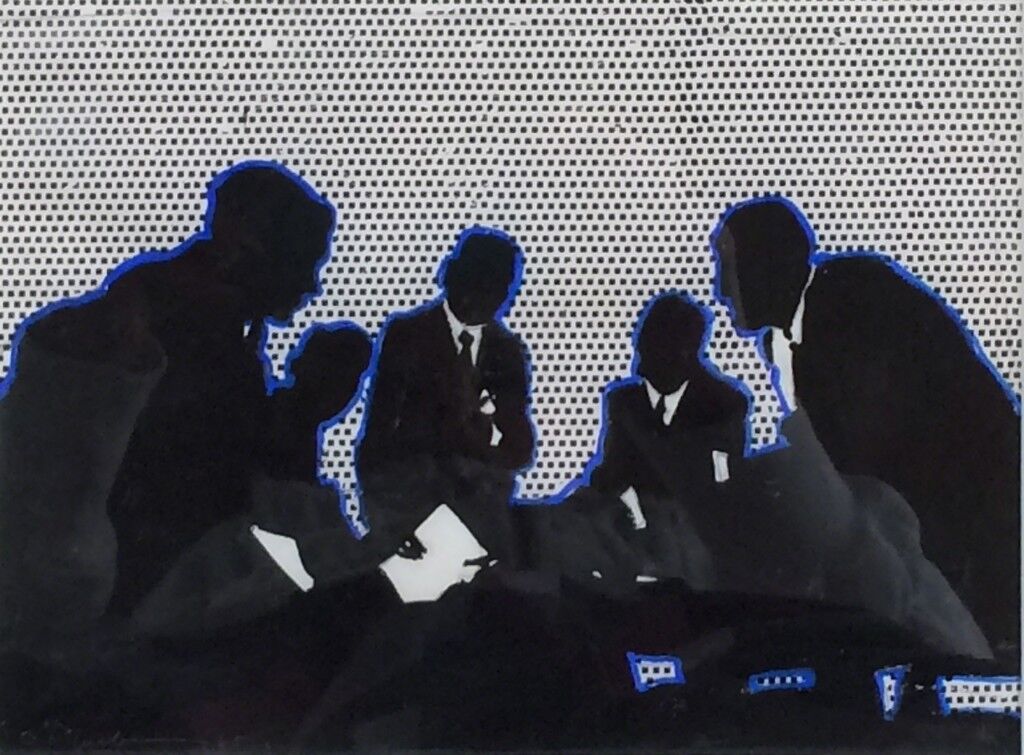
Idelle Weber. Press Type Firm, 1965.
The Michael Thomas Collection.
Nascida em Chicago, Weber mudou-se para Nova York aos 25 anos e foi incluída em uma exposição coletiva do MoMA no mesmo ano. Mostrando a influência de Edward Hopper, bem como sua formação em design gráfico, as obras de Weber contêm a linguagem clara, simplificada e de traços firmes da publicidade, mas são injetadas com uma melancolia enigmática. Em suas pinturas a tinta e aquarela, figuras anônimas, homens de negócios de terno, mulheres se exercitando, casais, destacam-se em silhuetas marcantes contra fundos padronizados. Mais arquetípicas do que individuais, elas capturam a uniformidade e o isolamento associados à vida urbana nos anos 1960. Não está claro se essas cenas pretendem ser uma crítica ou uma reflexão mais neutra sobre esse ethos. No entanto, elas se diferenciam de outras peças Pop produzidas em massa pela maneira como revelam sua pintura à mão de perto. Alguns acreditam que suas figuras inspiraram os créditos iniciais da série de sucesso “Mad Men”.
Chicago-born Weber moved to New York at 25 and was included in a MoMA group show the same year. Displaying the influence of Edward Hopper as well as her training in graphic design, Weber’s works contain the clear, simplified, and hard-lined language of advertising, but injected with an enigmatic moodiness. In her ink-and-watercolor paintings, anonymous figures—businessmen in suits, exercising women, couples—stand in stark silhouette against patterned backgrounds. Archetypal rather than individual, they capture the uniformity and isolation associated with urban life in the 1960s. It’s unclear whether these scenes are intended as a critique of or a more neutral reflection on this ethos. Nevertheless, they stand apart from other, mass-produced Pop pieces in the way they belie their hand-painting from close up. Her figures are thought by some to have inspired the opening credits for the hit TV show Mad Men.
KIKI KOGELNIK
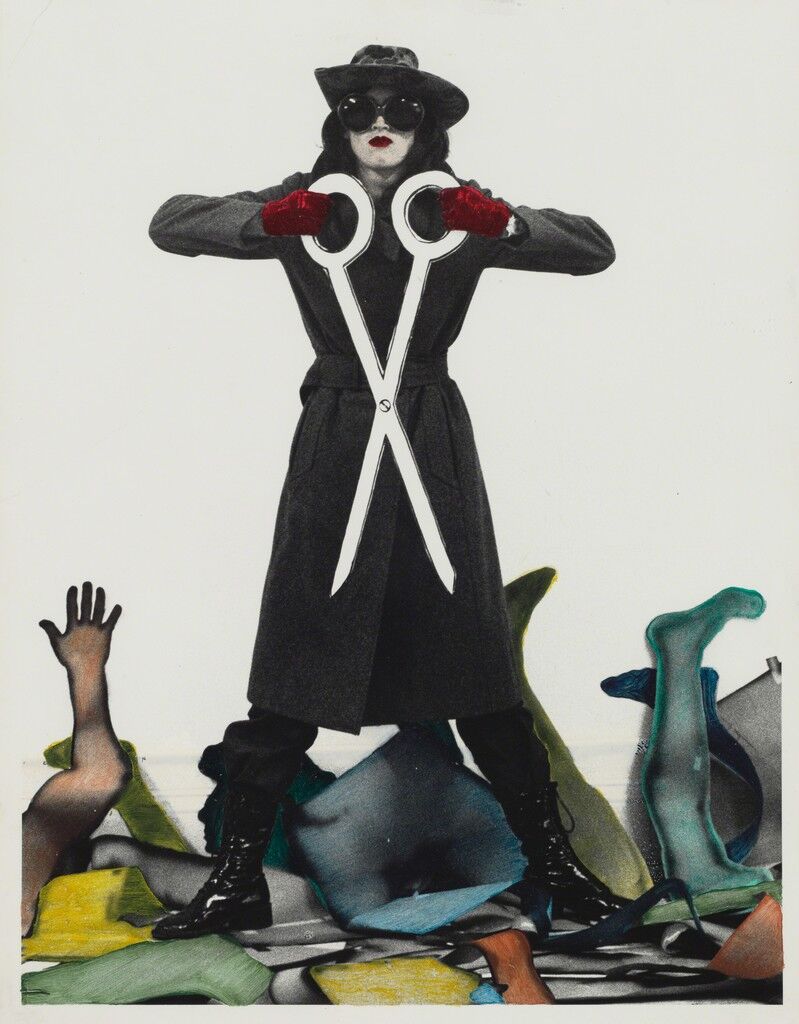
Kiki Kogelnik. Untitled (Woman´s Lib) ca. 1971.
Simone Subal.
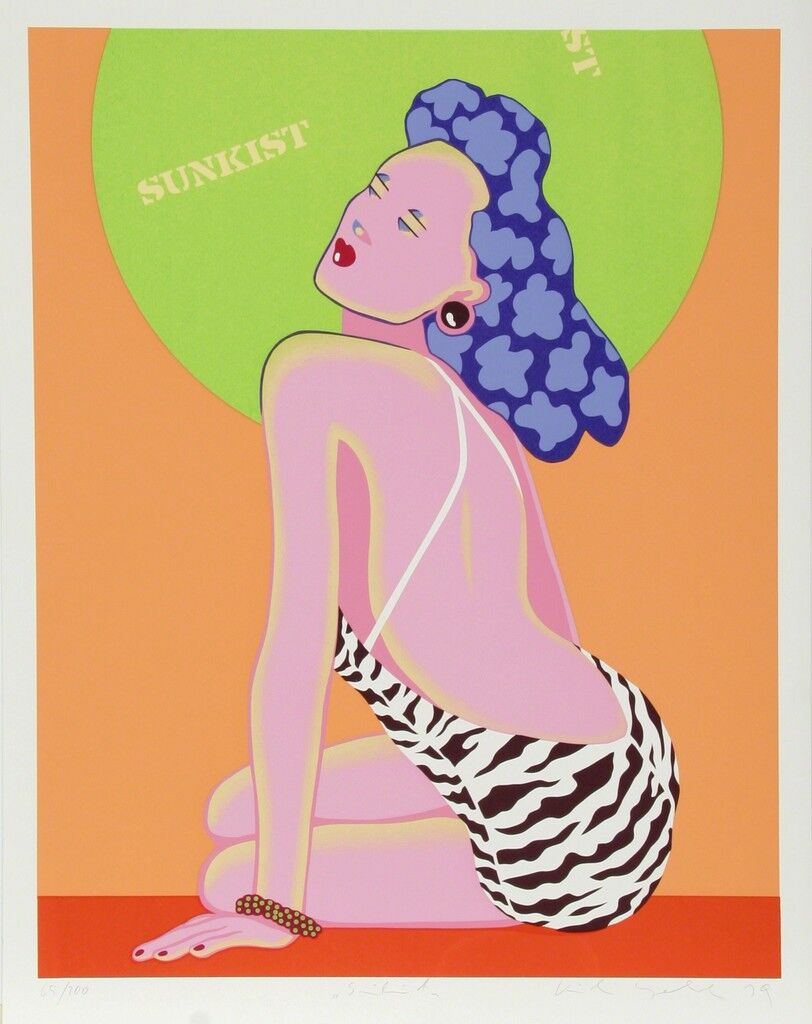
kiki Kogelnik. Sungist, 1981.
RoGallery.
Inicialmente envolvida com a pintura gestual abstrata vienense, a artista austríaca Kogelnik mudou-se para os EUA no início dos anos 1960 e rapidamente se encontrou entre nomes como Warhol, Lichtenstein, Joan Mitchell e Claes Oldenburg, em uma era marcada pela corrida espacial e pela revolução sexual.
Embora suas obras posteriores se assemelhem (e critiquem) anúncios de moda, sua produção dos anos 60 explora gênero, erotismo e a figura humana em relação ao desenvolvimento científico e tecnológico do pós-guerra. Em “Fly Me to the Moon” (1963), um foguete estilizado reflete o interesse particular de Kogelnik em viagens espaciais, enquanto as figuras feminina e masculina na cena ambíguamente navegam pelo cosmos ou se envolvem em sexo.
Distanciando-se de seus contemporâneos da Pop Art, Kogelnik disse que decidiu focar em foguetes em vez de latas de Coca-Cola. No entanto, nessas obras, contornos flutuantes de humanos-robôs, partes do corpo recortadas e o uso estratégico e muitas vezes econômico de cores falam da dissolução do indivíduo e da agência pessoal na sociedade consumista que a Pop Art criticava.
At first involved with Viennese gestural abstract painting, Austrian artist Kogelnik moved to the U.S. in the early 1960s and quickly found herself among the likes of Warhol, Lichtenstein, Joan Mitchell and classes Oldenborg, in an era characterized by the space race and the sexual revolution. While her later works resemble (and critique) fashion advertisements, her output from the ’60s explores gender, eroticism, and the human figure in relation to postwar scientific and technological development. In Fly Me to the Moon (1963), a stylized rocket speaks to Kogelnik’s particular interest in space travel, while the female and male figures in the scene ambiguously either cruise through the cosmos or engage in sex.
Distancing herself from her Pop contemporaries, Kogelnik said she decided to focus on rockets instead of Coca-Cola cans. Yet, in these works, floating outlines of humans-cum-robots, spliced body parts, and a strategic, often-sparing use of color tell of the dissolution of the individual and personal agency in the consumerist society that Pop critiqued.
Artigo de Rachel Lebowitz.
Cover image: Portrait of Corita Kent in her apartment c. 1970. Image courtesy of the Corita Art Center, Immaculate Heart Community, Los Angeles; Portrait of Marisol by Jack Mitchell, 1969. Image courtesy of El Museo del Barrio, New York; Portrait of Rosalyn Drexler via Wikimedia Commons.