


Flora and Zephyr (1875)
William Adolphe Bouguereau (1825-1905)
Na mitologia grega, Zéfiro, Ζέφυρος, Zephyros, ou Deus Zefir na religião pagã, é o Deus do vento do Oeste. É um dos filhos de Eos e Astreu, sendo seus irmãos Bóreas, Noto e Eurus. Foi casado com Íris e vivia numa caverna da Trácia. Na mitologia romana, este deus era associado a Favônio (Favônio, um dos deuses do vento romanos, que tinha domínio sobre as plantas e flores e era geralmente equiparado ao deus grego Zéfiro (seu retorno, todo ano, no início de fevereiro assinalava a chegada da primavera em Roma).
O mito do vento Zéfiro diz que este fecundava as éguas de certa região da Lusitânia tornando os cavalos dessa zona invulgarmente velozes. Consta na Ode Marítima de Avieno.
Um outro dos mitos em que Zéfiro aparece mais proeminentemente é o de Jacinto, um belo e atlético príncipe espartano. Zéfiro enamorou-se de Jacinto e cortejou-o, tal como Apolo. Ambos competiram pelo seu amor, que veio a escolher Apolo, fazendo que Zéfiro enlouquecesse de ciúmes.

Helios (sincretizado com Apolo)
Ἥλιος Hēlios; latinized as Helius; Ἠέλιος
Embora Hélios fosse uma divindade relativamente menor na Grécia Clássica, sua adoração tornou-se mais proeminente no final da Antiguidade graças à sua identificação com várias divindades solares importantes do período romano, particularmente Apolo e Sol. O imperador romano Juliano fez de Hélios a divindade central de seu breve renascimento das práticas religiosas tradicionais romanas no século 4 dC.
Mais tarde, ao surpreendê-los praticando o lançamento do disco, Zéfiro soprou uma rajada de vento sobre eles, fazendo com que o disco golpeasse Jacinto na cabeça ao cair. Quando Jacinto morreu, Apolo criou a flor homônima com o seu sangue.
Na história de Psiquê foi Zéfiro quem serviu a Eros transportando Psiquê até sua morada.
Zéfiro é também considerado uma brisa suave ou vento agradável, pois era o mais suave de todos os ventos tido por benfazejo, frutificante e mensageiro da Primavera.
O seu equivalente na mitologia romana é Favónio (Favonius, ‘favorável’), que exercia o domínio sobre a fauna e a flora, podendo controlar as plantas e os animais, versão cultuada na religião neopagã da bruxaria floral ao lado da Deusa Flora. Zéfiro é descrito como de "áureos cabelos" por Alceu de Mitilene. Hesíodo o chama de "o clareante" na Teogonia.
Helios is the son of Hyperion and Theia or Euryphaessa or Aethra. Homer in the Odyssey calls him Helios Hyperion ("the Sun up above"), with Hyperion used in a patronymic sense to Helios. In the Odyssey, Theogony and the Homeric Hymn to Demeter, Helios is once in each work called Ὑπεριονίδης, Hyperionides ("the son of Hyperion") and this example is followed by many later poets (like Pindar), who distinguish between Helios and Hyperion.
Helios is usually depicted as a handsome young man crowned with the shining aureole of the Sun who drove the chariot of the Sun across the sky each day to Earth-circling Oceanus and through the world-ocean returned to the East at night. In the Homeric Hymn to Helios, Helios is said to drive a golden chariot drawn by steeds; and Pindar speaks of Helios's "fire-darting steeds". Still later, the horses were given fire related names: Pyrois ("The Firey One"), Aeos ("He who turns the sky"), Aethon ("Blazing"), and Phlegon ("Burning").

In ancient Greek religion and myth, the Anemoi (Greek: Ἄνεμοι, "Winds") were wind gods who were each ascribed a cardinal direction from which their respective winds came (see Classical compass winds), and were each associated with various seasons and weather conditions. They were the progeny of Eos and Astraeus.
The Anemoi are minor gods and are subject to the god Aeolus. They were sometimes represented as gusts of wind, and at other times were personified as winged men. They were also sometimes depicted as horses kept in the stables of the storm god Aeolus, who provided Odysseus with the Anemoi in the Odyssey. The Spartans were reported to sacrifice a horse to the winds on Mount Taygetus.[4] Astraeus, the astrological deity (sometimes associated with Aeolus), and Eos/Aurora, the goddess of the dawn, were the parents of the Anemoi, according to the Greek poet Hesiod.
Mythology
Of the four chief Anemoi, Boreas (Aquilo in Roman mythology) is the north wind and bringer of cold winter air, Zephyrus (Favonius in Latin)[5] is the west wind and bringer of light spring and early-summer breezes, and Notus (Auster in Latin) is the south wind and bringer of the storms of late summer and autumn; Eurus, the southeast[6] (or according to some,[7] the east) wind, was not associated with any of the three Greek seasons, and is the only one of these four Anemoi not mentioned in Hesiod's Theogony or in the Orphic hymns.
The deities equivalent to the Anemoi in Roman mythology were the Venti (Latin, "winds"). These gods had different names, but were otherwise very similar to their Greek counterparts, borrowing their attributes and being frequently conflated with them. Ptolomy's world map listed 12 winds: Septentrio (N), Aquilo (NNE), Vulturnus (NE), Subsolanus (E), Eurus (SE), Euroauster (SSE), Austerulnotus (S), Euronotus (SSW), Affricus (SW), Ephirus (W), Eurus (NW), Circius (NNW).
Boreas (Βορέας, Boréas; also Βορρᾶς, Borrhâs) is the Greek god of the cold north wind and the bringer of winter. Although he was normally taken as the north wind, the Roman writers Aulus Gellius and Pliny the Elder both took Boreas as a northeast wind, equivalent to the Roman Aquilo. Boreas is depicted as being very strong, with a violent temper to match. He was frequently shown as a winged old man with shaggy hair and beard, holding a conch shell and wearing a billowing cloak. Pausanias wrote that Boreas had snakes instead of feet, though in art he was usually depicted with winged human feet. Boreas' two sons Calaïs and Zetes (the Boreads) were in the crew of the Argo as Argonauts.

Zephyrus the west-wind as spring, Greco-Roman mosaic
BOREAS
Boreas was closely associated with horses. He was said to have fathered twelve colts after taking the form of a stallion, to the mares of Erichthonius, king of Dardania. These were said to be able to run across a field of grain without trampling the plants. Pliny the Elder (Natural History iv.35 and viii.67) thought that mares might stand with their hindquarters to the North Wind and bear foals without a stallion. The Greeks believed that his home was in Thrace, and Herodotus and Pliny both describe a northern land known as Hyperborea "Beyond the North Wind" where people lived in complete happiness and had extraordinarily long lifespans. He is said to have fathered three giant Hyperborean priests of Apollo by Chione.
Boreas was also said to have kidnapped Orithyia, an Athenian princess, from the Ilisos. Boreas had taken a fancy to Orithyia and had initially pleaded for her favours, hoping to persuade her. When this failed, he reverted to his usual temper and abducted her as she danced on the banks of the Ilisos. Boreas wrapped Orithyia up in a cloud, married her, and with her, Boreas fathered two sons—the Boreads, Zethes and Calais—and two daughters—Chione, goddess of snow, and Cleopatra.
From then on, the Athenians saw Boreas as a relative by marriage. When Athens was threatened by Xerxes, the people prayed to Boreas, who was said to have then caused winds to sink 400 Persian ships. A cult was established in Athens in 480 B. C. E. in gratitude to the Boreas for destroying the approaching Persian fleet.[12] A similar event had occurred twelve years earlier, and Herodotus writes:
Now I cannot say if this was really why the Persians were caught at anchor by the stormwind, but the Athenians are quite positive that, just as Boreas helped them before, so Boreas was responsible for what happened on this occasion also. And when they went home they built the god a shrine by the River Ilissus.
The abduction of Orithyia was popular in Athens before and after the Persian War, and was frequently depicted on vase paintings. In these paintings, Boreas was portrayed as a bearded man in a tunic, with shaggy hair that is sometimes frosted and spiked. The abduction was also dramatized in Aeschylus's lost play Oreithyia.
ZEPHYRUS

Zephyrus the west-wind as spring, Greco-Roman mosaic
Zephyrus was reported as having several wives in different stories. He was said to be the husband of Iris, goddess of the rainbow. He abducted the goddess Chloris, and gave her the domain of flowers. With Chloris, he fathered Karpos ("fruit"). He is said to have vied for Chloris's love with his brother Boreas, eventually winning her devotion. Additionally, with yet another sister and lover, the harpy Podarge (also known as Celaeno), Zephyrus was said to be the father of Balius and Xanthus, Achilles' horses.
In the story of Eros and Psyche, Zephyrus served Eros (or Cupid) by transporting Psyche to his abode.
Zephyrus was also claimed to have killed one of Apollo's many male lovers Hyacinth out of jealousy. Hyacinth was killed by a discus thrown by Apollo. Though according to some sources, his death was said to be an accident, others said that Zephyrus was the true culprit, having blown the discus off course.
Zephyrus' Roman equivalent was Favonius (the 'favouring') who held dominion over plants and flowers. The Roman poet Horace writes:
quid fles, Asterie, quem tibi
candidi
primo restituent vere Favonii?
Why do you weep, Asterie, for the man whom the bright west windswill
restore to you at the beginning of spring?

Zephyrus and Hyacinth; Attic red-figure cup from Tarquinia, c. 480 BCE,
Museum of Fine Arts, Boston, EUA.
NOTUS (AUSTER)
Notus (Νότος, Nótos) was the Greek god of the south wind. He was associated with the desiccating hot wind of the rise of Sirius after midsummer, was thought to bring the storms of late summer and autumn, and was feared as a destroyer of crops.

Notus the south-wind as summer, Greco-Roman mosaic.
Notus' equivalent in Roman mythology was Auster, the embodiment of the sirocco wind, a southerly wind which brings cloudy weather, powerful winds and rain to southern Europe. (Auster named the compass point Australis and the country's name Australia.) The Auster winds are mentioned in Virgil's Aeneid Book II, lines 304–307:
in segetem veluti cum flamma
furentibus Austris incidit,
aut rapidus montano flumine torrens
sternit agros, sternit sata laeta
boumque labores,praecipitesque trahit silvas.
Just as when a flame falls on the standing grain while the South Winds rage,
or a rushing mountain stream lays low the fields,
lays low the glad crops and labors of oxen,
and drags down forests headlong.
aut, gelidas hibernus aquas cum
fuderit Auster,
securum somnos igne iuvante sequi
or when the winter South Wind has poured out
his cold waters,
to fall asleep carefree with the help of a fire.
EURUS
Eurus (Εὖρος, Euros) according to some was the southeast wind, but according to others the east wind. On the Tower of the Winds in Athens, Eurus occupies the southeast side, while Apeliotes is in the east. However, it is widely accepted that Eurus is the east wind, while Apeliotes is the southeast wind.

Eurus the east-wind as autumn, Greco-Roman mosaic.
Eurus' Roman counterpart is Vulturnus, according to Pliny the Elder;[22] but for Aulus Gellius Volturnus was the equivalent of the southeast wind Euronotus.
Generally in the Latin poets the name Eurus is used for the east or southeast wind, as in Greek.
Eurus is a wind of storm, described as a turbulent wind during storms and tossing ships on the sea. He is referred to as the “savior of Sparta” in a Homeric paean, or poem. Eurus is also called the “hot wind” by Nonnus in Dionysiaca. Eurus is closely related to Helios in passages of the Dionysiaca, being called from his place near Helios’ palace, Phaethon, where the sun rose in the east.


Wind rose of ancient Greece, created by the
scholar Adamantios Korais around 1796.
Ottavio Rinuccini (italiano, 1562-1621)
Zefiro torna, e di soavi accenti
l’aer fa grato e ‘l pie discioglie a l’onde,
e mormorando tra le verdi fronde,
fa danzar al bel suon su ‘l prato i fiori.
Inghirlandato il crin Fillide e Clori
note tempran d’amor care e gioconde;
e da monti e da valli ime e profonde
raddoppian l’armonia gli antri canori.
Sorge più vaga in ciel l’aurora, e ‘l sole
sparge più luci d’or: più puro argento
fregia di Teti il bel ceruleo manto.
Sol io, per selve abbandonate e sole,
l’ardor di due begli occhi e ‘l mio tormento,
come vuol mia ventura, hor piango hor canto.
O poema de Rinuccini é um metaplágio aos soneto de Petrarca ‘Torna Zéfiro e o bom tempo traz de volta’, nº 310 no Cancioneiro -, aparece no conjunto de Monteverdi em seu sexto livro de 1614; assim como alude às ninfas.
https://youtu.be/85tCzdRt6UE
‘Zefiro torna e di soavi accenti’, SV 251, madrigal para dois tenores com baixo contínuo (1632); com os tenores Jean-Paul Fouchécourt e Mark Padmore, conduzido por William Christie.
O ar agradecido se derrete nas ondas,
Murmura entre a verde ramagem,
Faz sua dança ao som das flores na campina.
Phyllis e Chloris, com guirlandas no rosto
Soltam notas alegres e doces como o amor
E das montanhas e vales profundos
Me rodopia o eco sonoro e harmônico das cavernas.
Levanta-se nas incertezas do céu da aurora
O sol a espalhar luzes de ouro ou prata pura
Enquanto Thétis ostenta seu manto cerúleo.
E eu, vagando abandonado à floresta e ao sol
Ardo ao brilho de dois olhos belos, o meu tormento,
Assim como minha ventura, eu choro, eu canto.
Zéfiro, o vento Oeste, era irmão de Bóreas e habitava na Trácia. A lenda descreve-o como um vento primitivamente violento, que destruía tudo com o seu sopro indomável: arrasava plantações, provocava naufrágios, causava grandes danos aos homens mas uma grande paixão o fêz mudar.
A súbita paixão de Zéfiro por Clóris – chamada de Flora pelos romanos – transformaou o caráter mitológico do vento dando-lhe uma versão benéfica. Clóris era a rainha da primavera e era quem espalhava a beleza das flores ao mundo, dando-lhes as cores e o perfume. O contraste com Zéfiro, o vento que destruia a beleza das flores, fêz com que Cloris o rejeitasse.
Mas o amor de Zéfiro era sincero, pleno e construtivo. Para conquistar Clóris, ele transformou a sua personalidade tempestuosa e destrutiva, tornando-se um vento suave que soprava lentamente para não danificar a beleza criada por sua amada. Representado na forma de um jovem com asas que anunciava a primavera e o renascer das plantas, Zéfiro e Clóris tiveram um filho, Carpo – o fruto.

Zephyrus the west-wind as spring, Greco-Roman mosaic from Antioch C2nd A.D., Virginia Museum of Fine Arts
THE ANEMOI were the gods of the four winds--namely Boreas the North-Wind, Zephryos (Zephyrus) the West, Notos (Notus) the South, and Euros (Eurus) the East. Each of these was associated with a season--Boreas was the cold breath of winter, Zephyros the god of spring breezes, and Notos the god of summer rain-storms.
The Winds were portrayed as either man-shaped, winged gods who lived together in a cavern on Mount Haimos (Haemus) in Thrake (Thrace), or as horse-shaped divinities stabled by Aiolos (Aeolus) Hippotades, "the Reiner of Horses", on the island of Aiolia and set out to graze on the shores of the earth-encircling River Okeanos (Oceanus).
Early poets, such as Homer and Hesiod, drew a clear distinction between the four, relatively benign, seasonal Winds (Anemoi) and the destructive Storm-Winds (Anemoi Thuellai). The latter, spawned by the monster Typhoeus, were either housed in the caverns of Aiolos or guarded by the Hekatonkheires in the pits of Tartaros. Later authors blurred the distinction between the two.
The female counterparts of the Anemoi were the Aellai Harpyiai (Harpies). Mated with the Winds they produced many swift, immortal horses.
VENTI (Anemoi), the winds. They appear personified even in the Homeric poems, but at the same time they are conceived as ordinary phenomena of nature. The master and ruler of all the winds is Aeolus, who resides in the island Aeolia (Virg. Aen. i. 52, &c.; comp. Aeolus) ; but the other gods also, especially Zeus, exercise a power over them. (Hom. Il. xii. 281.) Homer mentions by name Boreas (north wind), Eurus (east wind), Notus (south wind), and Zephyrus (west wind). When the funeral pile of Patroclus could not be made to burn, Achilles promised to offer sacrifices to the winds, and Iris accordingly hastening to them, found them feasting in the palace of Zephyrus in Thrace. Boreas and Zephyrus, at the invitation of Iris, forthwith hastened across the Thracian sea into Asia, to cause the fire to blaze. (Hom. Il. xxiii. 185, &c. ; comp. ii. 145, &c., v. 534, ix. 5, Od. v. 295.) Boreas and Zephyrus are usually mentioned together by Homer, just as Eurus and Notus. (Comp. Boreas and Zephyrus.) According to Hesiod (Theog. 378, &c., 869, &c.), the beneficial winds, Notus, Boreas, Argestes, and Zephyrus, were the sons of Astraeus and Eos, and the destructive ones, as Typhon, are said to be the sons of Typhoeus. Later, especially philosophical writers, endeavoured to define the winds more accurately, according to their places in the compass. Thus Aristotle (Meteor. ii. 6), besides the four principal winds (Boreas or Aparctias, Euris, Notus, and Zephyrus) mentions three, the Meses, Caicias, and Apeliotes. between Boreas and Eurus ; between Eurus and Notus he places the Phoenicias ; between Notus and Zephyrus he has only the Lips, and between Zephyrus and Boreas he places the Argestes (Olympias or Sciron) and the Thrascias. It must further be observed that according to Aristotle, the Eurus is not due east, but south east. In the Museum Pio-Clementinum there exists a marble monument upon which the winds are described with their Greek and Latin names, viz. Septentrio (Aparctias), Eurus (Euros, or southeast), and between these two Aquilo (Boreas), Vulturnus (Caicias) and Solanus (Apheliotes). Between Eurus and Notus (Notos) there is only one, the Euroauster (Euronotus); between Notus and Favonius (Zephyrus) are marked Austro-Africus (Libonotus), and Africus (Lips); and between Favonius and Septentrio we find Chrus (Iapyx) and Circius (Thracius). See the tables of the winds figured in Göttling's edit. of Hesiod, p. 39. The winds were represented by poets and artists in different ways; the latter usually represented them as beings with wings at their heads and shoulders (Ov. Met. i. 264, &c.; Philostr. Icon. i. 24).On the chest of Cypselus, Boreas in the act of carrying off Oreithyia, was represented with serpents in the place of legs (Paus. v. 19. § 1). The most remarkable monument representing the winds is the octagonal tower of Andronicus Cyrrhestes at Athens. Each of the eight sides of the monument represents one of the eight principal winds in a flying attitude. A moveable Triton in the centre of the cupola pointed with his staff to the wind blowing at the time. All these eight figures have wings at their shoulders, all are clothed, and the peculiarities of the winds are indicated by their bodies and various attributes. (Hirt, Mythol. Bilderb. p. 140, &c.) Black lambs were offered as sacrifices to the destructive winds, and white ones to favourable or good winds. (Aristoph. Ran. 845; Virg. Aen. iii. 117.) Boreas had a temple on the river Ilissus in Attica (Herod. vii. 189; comp. Paus. viii. 27. § 9), and between Titane and Sicyon there was an altar of the winds, upon which a priest offered a sacrifice to the winds once in every year. (Paus. ii. 12. § 1.) Zephyrus had an altar on the sacred road to Eleusis. (i. 37. § 1.)
Source: Dictionary of Greek and Roman Biography and Mythology.
Greco-Roman winds
Aeolus, keeper of the winds; later writers made him a full-fledged god
Boreas, god of the north wind and of winter
Eurus, god of the east or southeast wind
Notus, god of the south wind
Zephyrus, god of the west wind
Aparctias, another name for the north wind (not identified with Boreas)
Apheliotes, god of the east wind (when Eurus is considered southeast)
Argestes, another name for the west or northwest wind
Caicias, god of the northeast wind
Circios or Thraskias, god of the north-northwest wind
Euronotus, god of the southeast wind
Lips, god of the southwest wind
Skeiron, god of the northwest wind
Aura, the breeze personified
Aurai, nymphs of the breeze
Cardea, Roman goddess of health, thresholds, door hinges, and handles; associated with the wind
Venti, (Latin, "winds") deities equivalent to the Greek Anemoi
Bóreas (N), o vento norte, frio e violento; em latim Aquilon.
Zéfiro (O), o vento oeste, suave e agradável; para os romanos Favonius.
Euro (L), o vento leste, criador de tempestades; para os marinheiros romanos Vulturnus.
Noto (S), o vento sul, quente e formador de nuvens; em latim Auster.
Segundo Aulo Gélio, Bóreas (em grego) ou Áquilo (em latim) é o vento que sopra a partir da direção do sol nascente no solstício de verão
ART, SCIENCE AND LIFE
In Greek mythology, Karpos: Καρπός = Karpós; Latin: Carpus, literally "fruit"), was a youth renowned for his beauty. He is the son of Zephyrus (Ζέφυρος : Zéphyros), the west wind) and Chloris (Χλωρίς : Chlōrís, spring, or new vegetation), forming a natural metaphor, the west wind heralds the new growth of spring, which then bears fruit.
Karpo, one of the Horae, is the feminine equivalent of Karpos; her dominion being the fruits of the earth.
The story, told in Nonnus's Dionysiaca, tells about the love of two youths, Karpos and Kalamos, son of Maiandros (god of the Maeander river). Karpos drowned in the Meander river while the two were competing in a swimming contest and in his grief, Kalamos allowed himself to also drown. He was then transformed into a water reed, whose rustling in the wind was interpreted as a sigh of lamentation
The word Karpos derives from the Proto-Indo-European language root kerp-. Cognates can be found in many Indo-European languages including modern English in words such as "harvest" (via germanic), "carpet", "excerpt" and "scarce" (via Latin). Coming to English directly from the Greek karpos are the following:
the prefix carpo-: meaning fruit. e.g. carpophagous, "fruit-eating"
the suffixes: -carp and -carpous, also meaning fruit. e.g. ascocarp, pericarp, mesocarp.
Carpology: the study of fruits and seeds
Carp: a fruiting body of a fungus
The proper name Carpophorus literally fruit-bearing.
A well-known expression in Latin is carpe diem ("pluck the day") from the Latin verb carpo, cognate to the Greek καρπός : karpós.


Sandro Botticelli. Primavera, c. 1482 – têmpera sobre madeira (202 x 314 cm) Uffizi Gallery, Florence.


Timekeeping in the Ancient World: Sundials
In the time of the ancient Greeks and Romans, the earth was considered the centre of the universe, which was itself a sphere containing all the stars. This celestial sphere rotated from east to west, carrying not only the stars but also the sun and the planets. Therefore, the sun revolved around the earth. This is what caused day and night. The earth did not rotate. For the purpose of understanding sundials, it is perfectly acceptable and convenient to adopt this geocentric view. The sun did not travel around the earth in a circle at right angles to the earth's axis (which was also the axis of the celestial sphere) as the stars did. Rather, the sun traced a circle along the celestial sphere, centred on the earth, known as the ecliptic.
The ecliptic plane meets the equatorial plane at approximately 23.5°. This is known as the obliquity of the ecliptic. The circle of the ecliptic more or less intersects the twelve constellations of the zodiac, and the time of year (corresponding to modern months) was reckoned by what sign of the zodiac the sun was traversing. (Regardless of the exact location of the zodiac constellations, the ecliptic was divided into 12 equal arcs of 30° each, leaving most of the constellations off-centred and often not entirely in their designated 30° region.) The sun's motion along the ecliptic circle takes a (solar) year. The dual motion of the sun (on the celestial sphere and along the ecliptic) means that the sun follows a different path in the sky each day. From the perspective of the northern hemisphere, during the summer, the sun is higher in the sky and remains visible for a longer period of time. Since the ancients always divided the daylight into twelve equal hours, these summertime hours were longer. In the winter months, the sun is lower in the sky and visible for a shorter period of time. Consequently, the winter hours were also shorter.

In the early ages of Rome and even down to the middle of the fifth century after the foundation of the city no other divisions of the day were known than sunrise, sunset and midday, which were marked by the arrival of the Sun between the Rostra and a place called Graecostasis.
The single greatest literary source that exists for the sundials of Greece and Rome is Vitruvius's Ten Books on Architecture written about 25 B.C. In Book 9, Vitruvius gives a list of a variety of dials and their inventors [2]:
Berosus the Chaldaean is said to have invented the semicircular one carved out of a squared block and undercut to follow the earth's tilt. The hemisphere, or scaphê, is attributed to Aristarchus of Samos, and he also invented the disk on a plane. The Spider was invented by Eudoxus the astronomer; some say by Apollonius. The Plinth or Coffer, of which an example is set in the [region of the City known as the] Circus of Flaminius, was invented by Scopinas of Syracuse; Parmenion invented the "Sundial for Examination"; Theodosius and Andrias the sundial "For Every Climate," Patrocles the Axe, Dionysodorus the Cone, Apollonius the Quiver. The men named here invented other kinds, and many others have left us still other kinds, like the Spider-Cone, the Hollowed Plinth, and the Antiboreus ("Opposite the North"). Many, moreover, have left behind written directions for making portable and hanging versions of these kinds. Anyone who wants to may find additional information in their books, so long as they know how to set up an analemma.
Vitruvius's analemma is the system of lines and curves that denote the changing hours and months on the face of a sundial. His previous chapter is devoted to determining the analemma based upon the observance of the shadow of a gnomon at noon on the equinox. (The gnomon was the upright stick that cast its shadow on the dial face. Depending on the design of the dial, either the side of the shadow's length or the position of the tip of the shadow was used to determine the time.) Unfortunately, Vitruvius ends his discussion of sundials with the list given above and writes of water clocks for the rest of Book 9.
Before the Greeks developed the sundial into the forms Vitruvius lists, the more ancient civilizations of Egypt and Mesopotamia had shadow measuring devices as early as 1500 B.C. Though this is the date of the earliest surviving sundials [3]:
... it is possible that sundials were invented as early as the third millennium when Egyptian priests began to divide the night and day each into twelve equal parts.
A funerary text from 1290 B.C., referring to astronomical events in the 19th century B.C., gives instructions on how to construct a "shadow stick."[4]
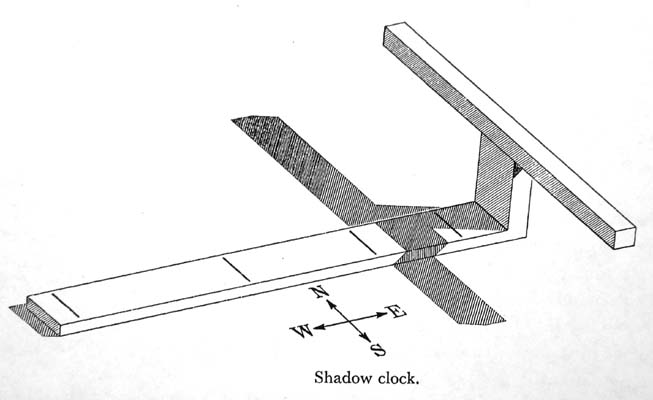
This shadow clock consisted of a base with an upright stick at one end. Because of the angular shift in the shadow over the course of the day, it has been speculated that the upright had a crossbar added to it to widen the shadow so that it would always fall on the clock. Neither the funerary text nor surviving examples have the crossbar, though one specimen has holes on either side of its upright which may suggest such an addition.[4]
In practice, the shadow clock needed to be rotated once a day at noon in order to be able to mark the time in both the morning and afternoon [5]:
Two hours are said to have occurred before the sun struck the clock in the morning, and another two hours passed after the sun left the clock but before night began. The assumption is that the morning twilight before sunrise was counted as one hour, and that another hour passed between sunrise and when the upright cast an observable shadow on the clock. (The shadow at sunrise would be infinite in length, and so useless for marking the hour.) Two hours similarly passed in the evening.[5] The markings on the clock indicating the four hours were very inaccurate, and were possibly not based on observation but rather some fallacy of celestial geometry.[4]
Sundials resembling the kind of which Vitruvius speaks were in use in Egypt from at least 1200 B.C. These were vertical hanging sundials, semicircular in shape with a horizontal gnomon at the top and centre. "The shadow would sweep around such a dial more rapidly in the early morning and late afternoon than around midday, but the Egyptians simply divided the dial into 12 15° sectors or 'hours'. This is perhaps the crudest order of gnomon use and provides little of either theoretical or empirical interest for the Greeks."[4] Further Egyptian development in timekeeping seems to have waned until the Assyrian invasion in the 7th century B.C.[4]
A near complete sundial was found at Kantara, Egypt dating back to approximately 320 B.C., well over a thousand years after the shadow clocks were in operation [6]:
The gnomon was a perpendicular block rising at the foot of the sloping face, its height and width being the same as those of the latter. On one side was an arrangement whereby a plummet could be hung so as to swing free of the base. The instrument was put down on a flat surface, and whenever it was to be used, was turned so that it faced the sun directly. The shadow of the gnomon then fell upon the face. The spaces marked off by the parallel lines running from top to bottom of the face showed where the shadow was to be read during the different months of the year, starting with the summer solstice at one edge and turning back again with the winter solstice at the other.
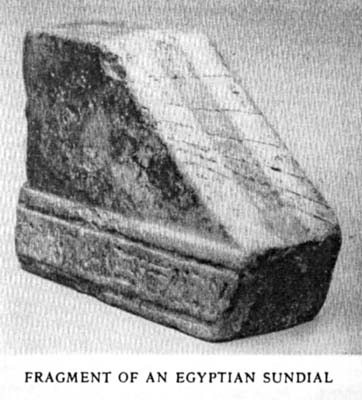
Along the face was a set of obliquely drawn lines sloping from the winter solstice edge to the summer solstice edge.
At six in the morning the shadow would strike the top of the dial; as the sun rose higher the shadow would decrease in length until at noon it touched the lowest line; it reached the top of the dial again at six in the evening.
This sundial and others of similar design that survive today are not terribly accurate [6]:
Certain modifications would have been necessary if they were to tell the correct time. Part of this inexactness may have been due to their being representations of larger or more accurate instruments, although dials of this type must either have been small enough to handle or else have had some sort of arrangement whereby they could be turned about easily.
In the Greek world, the earliest sundials "consisted of a gnomon in the form of a vertical post or peg set in a flat surface, upon which the shadow of the gnomon served to indicate the time."[7] This is as opposed to modern designs that have their gnomon slanted parallel to the earth's axis. In this modern system, lines on the dial face denoting the hours issue from a central point and remain straight. It is the shadow of the edge of the gnomon lying on these lines that gives the time. Seasonal variations are practically immaterial [7]:
In the ancient dials with vertical gnomon, the direction of the shadow at any given time of day varied with the seasons. Thus it was the position of the tip of the shadow that was essential to the determination of the hour. The shadow's tip traced a curve on the dial plane as the sun moved, a curve which changed from summer to winter.
The curves traced out on the dial of such a sundial may have led to the discovery of the conic sections, as attributed to Menaechmus in the fourth century B.C.[7]
It should be noted that the solstitial curves are only hyperbolae between the Arctic and Antarctic circles. The equinoctial curve is a line at every latitude except the poles.[8] The solstitial lines at the Arctic and Antarctic circles would be parabolae and within the circles, they would be ellipses. The ellipse is easy to see as during the Arctic day, the sun makes its full circuit above the horizon, and thus a gnomon's shadow would map out the closed conic section.[7]
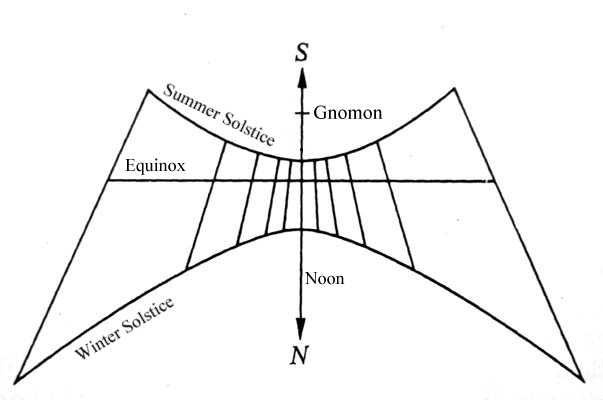
The pattern consisted of a hyperbola tracing the shadow's path at the winter solstice, a second for the summer solstice, and a straight east-west line in between marking the equinoctial shadows. A line from the base of the gnomon at the south of the dial running due north denoted noontime. (Since the shadow of the tip of the gnomon was the time telling device, the gnomon may have been inclined. The angle of the gnomon is irrelevant.[9] In such a dial, the noon line would run from the base of a perpendicular line between the gnomon's tip and the dial surface.) The hyperbolae were centred on this noon line. The winter hyperbola opened north, the summer hyperbola south (assuming the dial is in the northern hemisphere). In addition to the centre noon line, additional oblique lines were added on either side to denote the hours of daylight before and after noon [8]:
It is obvious from preserved examples of horizontal dials that straight lines which connect hour points on the summer solstice, equinox, and winter solstice served to approximate these hour lines in Graeco-Roman antiquity.
Furthermore:
... the solstitial day curves on almost all preserved horizontal dials have been approximated by broken lines which connect the hour points. This seems to indicate that the dialer located these hour points on the dial face before engraving the day curves.
It is still a matter of debate whether some, if not all, sundials of this type were drawn by observation or calculation. Evidence does exist which suggests methods of projection were used to determine the hour points [8]:
Both Vitruvius and Ptolemy describe analemmas which for given solar positions serve to determine length and direction of the shadow cast by a gnomon on the face of a planar sundial.
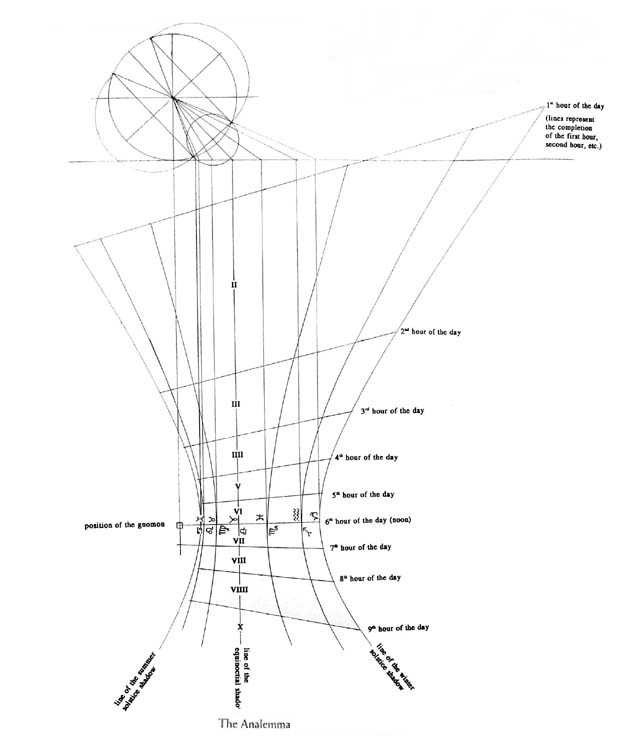
Specifically, in his book, 'On the Analemma', Ptolemy gives methods for deriving, both by trigonometric and also by graphic means, three pairs of spherical coordinates for the sun relative to a given place on earth, given solar declination, terrestrial latitude, and hour of the day. Though he does not say so explicitly, each pair of spherical coordinates is singularly suited for finding the length and direction of a gnomon's shadow for a type of plane sundial.
To complicate matters, the exact specifications of a sundial's network of curves varied with the sundial's latitude. If mathematical means were used to create the pattern on a sundial, it should be expected that the intended latitude would be taken into account. However, sundials have been found in latitudes that vary as much as 7 degrees latitude (a distance of over 700 kilometres). The most significant instance of such a discrepancy was the sundial that was the first official timepiece of Rome. The Romans captured a sundial during a war on Sicily in 264 B.C. Notwithstanding the difference of about 4 degrees latitude, the sundial served Rome for almost one hundred years before a new dial calibrated for the city was set up. This was despite the time being in observable error [9]:
Although the shadow of a stick in the ground appears to be the simplest form of timekeeper, the horizontal dial is more complex to mark off into the hour spaces for the temporary hour system than are the dials of spherical or conical section ... since a basic understanding of the origins of the hyperbolic shadow paths on the plane surface is necessary in order to adapt the geometrical figure needed to make it.
The geometrical figure is the analemma which Vitruvius spoke of above. The analemma is the:
... projection of the celestial sphere into one plane, from which in turn the positions of the hours on the dial's surface were deduced. Vitruvius describes the basic figure ... though his text at this point is somewhat obscure and he may well have not clearly understood what he was describing in any case.
After describing how the equinoctial line can be found, as well as the point of noon on the solstices, Vitruvius closes his thoughts on the analemma as follows [2]:
Once this construction has been drawn and executed as specified, for the winter lines and for the summer, for the equinoctial lines and the monthly lines, then, in addition, the system of hours should be inscribed along the form of the analemma. To these can be added many varieties and kinds of sundial, and they are all marked off by these inventive methods. However, the result of all these figures and their delineation is identical: namely, that the day at the equinox and at the winter solstice, and again at the summer solstice, is equally divided into twelve parts. Therefore, I have not chosen to omit these matters as if I were deterred by laziness, but so as not to cause annoyance by writing too much ... . Therefore I shall simply tell about the kinds that have been handed down to us, and by whom they were invented.
Vitruvius's dismissiveness supports the claim that he did not fully understand the adaptation of the analemma to the sundial. And though he states that any sundial can be constructed from the analemma, it is only later authors who give the details of such constructions.[9]
Whilst the initial construction required a greater effort, the ease with which day and hour lines could be drawn made spherical sundials in antiquity more popular than their flat counterparts.[9] The basic principle of the spherical sundial was that it mirrored the celestial sphere in which the sun travels. The basic construction involved hollowing out a hemisphere (or smaller wedge of a sphere) with its top parallel to the horizon. A gnomon was set up so that its point was at the centre of the hemisphere flush with the plane of the horizon. On any given day, the shadow cast by the tip of the gnomon would trace out the arc of a circle on the surface of the dial.
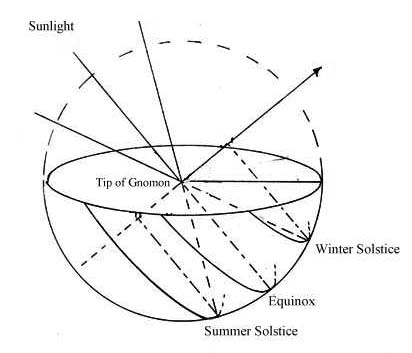
The arc of the summer solstice was farthest towards the bottom of the hemisphere. As the seasons shifted toward winter, these arcs were closer and closer to the upper edge of the hemisphere. These daily arcs were all parallel, and the arc of the equinox was half of a circle with the same centre as the hemisphere (a great circle).[8] The hour lines were not circular curves, with the exception of those at the horizons (marking sunrise and sunset) and the noon line. These were great circles which ran perpendicular to the equinoctial circle [8]:
In spite of their noncircular nature, for latitudes below 45° [which includes the whole of the Mediterranean Sea] the seasonal hour lines between meridian and horizon are very closely approximated by the great circles which do pass through corresponding seasonal hour points on solstitial and equinoctial curves. The engraved hour lines on preserved spherical sundials appear to be such great circle approximations. The deviation of the hour lines from great circles cannot even be detected on the few dials where more than three day curves have been divided.
Thus the marking of the hour lines needed neither careful observations nor complicated mathematics. All that was needed was to divide the area of the hemisphere that received the gnomon's shadow into twelve equal parts using great circles, in much the same way as a modern globe is divided into lines of longitude. To simplify the spherical dial even more, the day curves did not need to correspond to the equinoxes or solstices if the dial's only purpose was to act as a clock. Two or three parallel circular arcs were all that were needed for ease of reading (being the corresponding lines of "latitude"). Several examples of such dials were found in such sites as Pompeii, Herculaneum, Ostia, and Rome. It was only when the dial was to serve as a calendar that these lines needed to correspond to the equinoxes and solstices.[8]
Bibliografia
https://ninaarizzi.wordpress.com/2013/06/06/torna-zefiro/
https://www.theoi.com/Titan/Anemoi.html#:~:text=THE%20ANEMOI%20were%20the%20gods,god%20of%20summer%20rain%2Dstorms.
https://en.wikipedia.org/wiki/List_of_wind_deities
https://pt.wikipedia.org/wiki/Ventos_(mitologia)
https://en.wikipedia.org/wiki/Helios
https://www.researchgate.net/publication/252061612_First_in_a_series_on_the_evolution_of_time_measurement_Celestial_flow_and_mechanical_clocks_Recalibration
http://www.murlocultura.com/site/murlocultura/94-anno2018/murlocultura-2018-nr-3-4/470-la-torre-dei-venti-di-atene

Nenhum comentário:
Postar um comentário