VASOS GREGOS
"REVISÃO DA LITERATURA"
INTRODUÇÃO A FORMA DOS VASOS GREGOS
Visite o site da University of Oxford
Between c.800 - c.300 B.C., the range of painted pottery shapes is relatively limited. Most look broadly similar throughout the period, but their variations and refinements can serve as a useful guide for relative dating. The Athenian examples cover all of the most important forms, although it is helpful to keep in mind local undecorated (coarse) and plain (black-gloss) wares, pottery from other regions, such as Corinth and East Greece, and other materials. Vessels made of metal, glass and wood tend not to preserve as well as pottery, and our record of shapes is consequently skewed in favour of the ceramic evidence. There are however a number of features in the pottery repertoire that seem more suitable to other materials, e.g., rivet-like attachments.
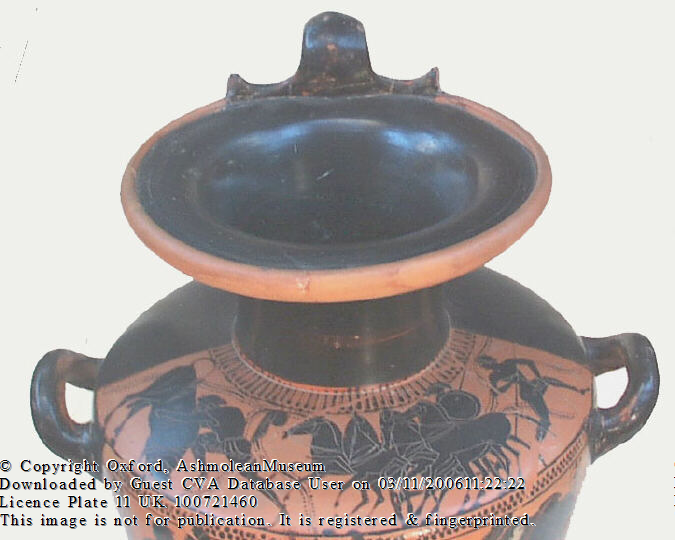
Only occasionally do we know the ancient names by which the different shapes were known, either from literary sources (mostly later) or merchants' marks, and so many names used today may not have been applied in the same way in 600-300 B.C. In some cases, a name reflects function, but it is images of the vessels in use, often on painted pots themselves, that provide the most reliable clues. Certain shapes have a particular connection with religious rituals, but a wide range of vessels can be deposited in graves or dedicated in sanctuaries.
Sir John Beazley's attributions relied not only on careful analysis of the painted decoration, but also the potting, and he and subsequent scholars have identified potters (or at least 'classes'), as well as painters. This endeavour is aided by epoiesen inscriptions, which may mean that 'so-and-so made it'.
Amphorae
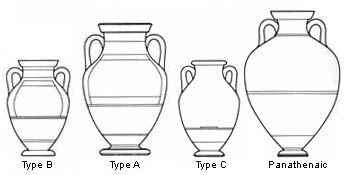
The amphora (pl. amphorae; from Greek amphi - on both sides, phero - carry) is a two-handled pot with a neck that is considerably narrower than the body. It was used for the storage of liquids and solids such as grain. Undecorated 'coarse' amphorae, with their lower part tapering to a point, were the standard transport containers in the Mediterranean. They are frequently depicted in symposium scenes. Panathenaic prize amphorae are perhaps the closest in shape, but the majority of painted amphorae are grouped into two main types, the one-piece belly-amphorae, and neck-amphorae, which have a clearly-marked neck. Also discussed here is the pelike, another two-handled storage vessel.
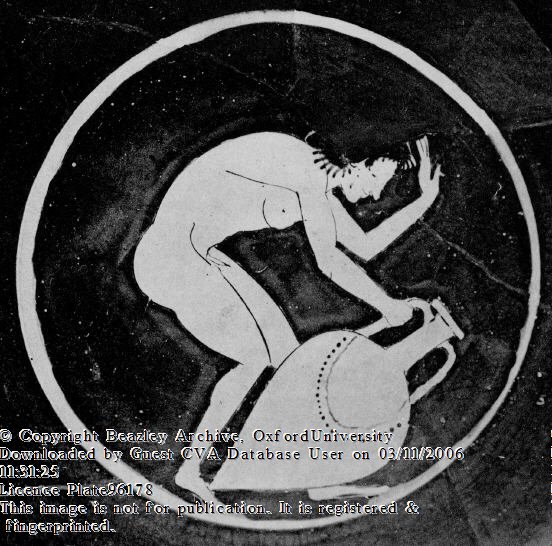
Belly amphora
The belly-amphora has a continuous profile from lip to foot. It is usually lidded.
Type B amphora
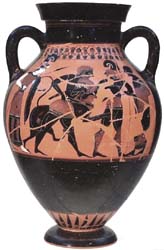
The most typically occurring form is termed Type B, characterised by the combination of round handles, the mouth's straight lip, and the convex profile of the one-piece foot (termed 'echinus'). The shape is old, dating back to the seventh century, and continuing to be produced until the mid-fifth century.
Type A amphora
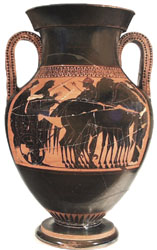
During the third quarter of the sixth century, a new, more elaborate type is introduced. Type A amphorae are recognisable by their flat, flanged handles, often decorated with ivy, and two-part ('stepped') foot.

Type C amphora
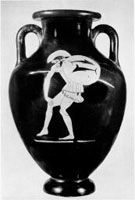
A third type, Type C, is less common. Like Type B it has a one-piece foot, but the lip is round ('torus') rather than straight.
Panathenaic prize amphora
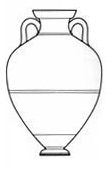
The broad body, narrow neck and foot of Panathenaic amphorae gives a shape reminiscent of transport amphorae. They served as prizes in the Panathenaic Games, containing oil for victors. The Games seem to have been established in Athens in the 560s, and the earliest examples of the shape can be dated to around the same time. Panathenaic amphorae are useful for dating, since they continue to be produced well after the fourth century, becoming more elongated and elaborate. From the fourth century, the name of the archon for the year is inscribed, permitting an unusually precise means of fixing chronology.
Panathenaic amphorae are only decorated in the black-figure technique. Athena always appears on one side, with the inscription "ton Athenethen athlon" - a prize from Athens. The event for which the vase was a prize is depicted on the other side
Amphorae 'of Panathenaic shape' refer to vases of this shape that are decorated in different ways, such as those in red-figure. Smaller versions also occur, perhaps as souvenirs.
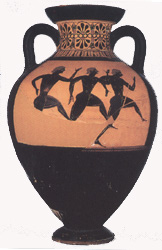
Athenian amphora ht. 49.5cm. Panathenaic shape
Neck-amphora
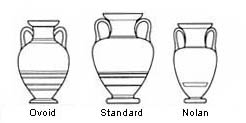
The neck-amphora is identifiable by its clearly defined neck. The shape is old, recognisable among Geometric and Protoattic vases. In Athenian black-figure, examples can be ovoid (notably the so-called Tyrrhenian amphorae, which seem to have been made for an Etruscan market), but the standard type has a more obvious 'shoulder', perhaps inspired at some stage by East Greek shapes. Another distinct type is the strap-handled Nikosthenic amphorae. These imitate a shape found in Etruscan bucchero, and the find-spots suggest that an Etruscan market was intended.
Neck-amphorae continue to be decorated with the black-figure technique, but later examples (from c.500) are often smaller. Those with double-reeded handles are termed 'doubleens'. Among the various types found in red-figure, distinctive are the small Nolan amphorae, identifiable by their high necks, and named after Nola where many examples were found.
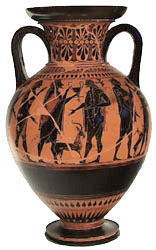
Athenian ovoid ht. 40cm.
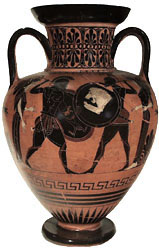
Athenian standard ht. 38cm.
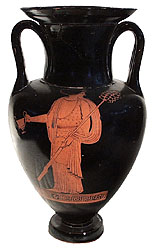
Athenian red-figure Nolan ht. 32cm.
Pelike
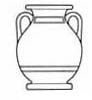
The Greek term pelike (pl. pelikai) was used for a number of shapes, and we do not know what this one-piece vessel with a distinctive sagging belly was called in antiquity. It seems to have been invented after the introduction of the red-figure technique, although there are examples in black-figure. It continues to be produced into the fourth century. It is shown in use as a container for liquids.

Athenian black-figure pelike ht. 38cm
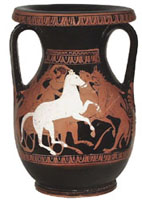
Athenian red-figure pelike 4th century ht. 28cm
Kraters

The term 'krater' suggests a mixing-vessel (compare Greek kerannumi to mix), and we know that the wine served at the symposium was mixed with water. On vases decorated with symposium-scenes, a large open container with a foot is often depicted, and the name krater is appropriate. Examples can be traced back to the large Geometric examples that were used as grave-markers, and this funerary connection continues to be important. Excavations of burial-sites have shown that they could be used in Greek settlements overseas as containers of ashes, and South Italian, especially Apulian, volute-kraters often carry explicit funerary iconography. In the Athenian repertoire, there are four main types identified today: column, volute, calyx and bell. The psykter is a short-lived shape, used to cool the liquid. It is discussed here because it is often shown being used in kraters.
Column-krater
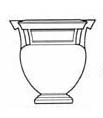
Named for its column-like handles, the column-krater is first known from Corinthian examples dated to the late seventh century. It is regularly produced by Athenian potters from the first half of the sixth-century until the third quarter of the fifth. It seems from graffiti on Athenian red-figure examples that the vessel was referred to as Korinthios or Korinthiourges.
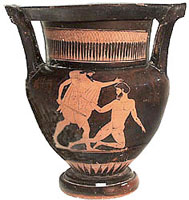
Athenian red-figure column-krater ht. 35cm.
Volute-krater

The volute-krater is named after its handles. The François Vase is a famous and early example, but the typical Athenian form occurs only later in the sixth century, with the handles tightly curled so that they look like the volutes on Ionic columns. The shape is also found in metal. Over the course of the fifth and fourth centuries, examples become slimmer, and Apulian volute-kraters from South Italy are particularly elaborate.
O volute-krater tem o nome devido às suas alças. (Voluta em Arquitetura é um Ornamento espiralado que remata os ângulos do capitel jônico, coríntio e compósito). O Vaso François é um exemplo famoso e antigo, mas a forma ateniense típica ocorre apenas no final do século VI, com as alças firmemente enroladas para que pareçam as volutas das colunas jônicas. A forma também é encontrada em metal. Ao longo dos séculos V e IV, os exemplos se tornam mais afilados, e os krateras Apulianos do sul da Itália são particularmente elaborados.
Calyx-krater
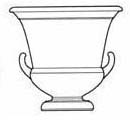
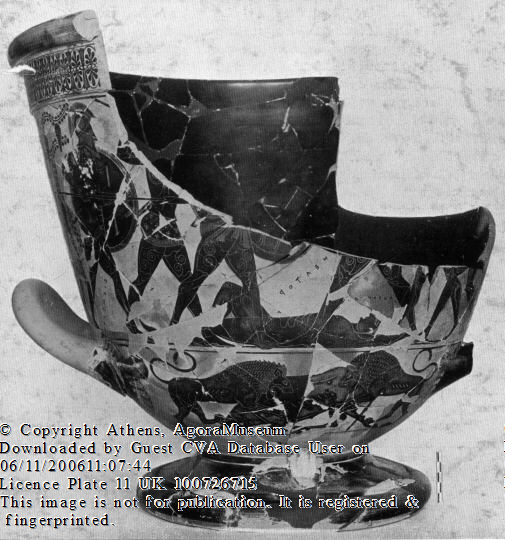
As alças do cálice-krater são colocadas abaixo do corpo, no que é chamado de cul. Sua forma curvada para cima confere à forma uma aparência que lembra o cálice de uma flor, daí o nome. O exemplo mais antigo conhecido foi possivelmente feito por Exekias no terceiro quartel do século VI. Continua sendo produzido, principalmente em figuras vermelhas, tornando-se mais alongado ao longo dos séculos V e IV.
Bell-krater

Kratera sinoide (em forma de sino)
O mais recente dos quatro tipos de Krater, ocorre pela primeira vez no início do século V, e não é encontrado decorado com figuras negras. É nomeado por sua forma de sino, talvez originário de madeira. Possui pequenas alças horizontais viradas para cima, na metade do corpo. Alguns não têm pés, e exemplos anteriores podem ter alças para alças. Ao longo dos séculos V e IV, a forma se torna mais fina.


ANCIENT GREEK POTTERY AND CERAMICS

Lamb rhyton from 460 BC
Ceramics created by the Greeks were far superior to anything made by civilizations that preceded it. The Greeks produced vases, urns and bowls. They were known for their craftsmanship. The most famous pieces were vases with paintings such as Apollo playing a tortoise shell lyre. Unlike oriental pottery which came in all kinds of shapes, ancient Greek pottery was more limited, comprised of only a few dozen shapes that changed little over time.
According to the Canadian Museum of History: “The art of making pottery was first developed in the Neolithic Period. Coils of clay were used to build up the body of the vase. The artisan would dig up the material from clay beds and get rid of impurities. This was done by a process called levigation- mixing the clay with water so that heavier particles sink to the bottom and lighter materials float on top. The clay might have to be washed several times before there was a sufficient quantity of suitable clay that could then be kneaded by the artisan into ropes suitable for coiling.
Around 1800 B.C. the potter's wheel was introduced. As the wheel spun, the clay would be pulled up by the fingers into the required shape. Large pots were done in several sections and the sections joined together by slip (a mixture of clay and water). The joins on the outside of the vessel are usually not noticeable but they can often be seen on the inside of the pot. The foot, the spout and the handles were also produced separately. Like the body sections, the clay was allowed to dry until it had achieved the consistency of leather at which point they were joined with the slip. The parts are so well integrated in a quality Greek vase that nothing appears to be simply “stuck on”. If the vase was to be decorated (and common or coarse wares were not), it was done at this point.
Ancient Greek Vase Paintings
The earliest ancient Greek vases were decorated with abstract designs and geometric figures (8th century B.C.). During the 7th century the human figures became larger and more life-like and by the 6th century Greek art had evolved into the classical vase art. Many were painted on kraters-ceramic pots that held about 48 liters and were used for mixing wine and water.

Red-figure painting
The first vessels with figures were made by Cornithian potters in the 7th century B.C. They featured black figures on the natural color of the pottery. The figures were black silhouette with a design scratched out with a needle. White and purple were painted on the black silhouette to highlight certain features.
On the red figure vases of the 6th and 5th centuries B.C. the process was reversed with a few red silhouettes and a large black background on which the figures were painted instead of inscribed. The "red figure" style, it is said, was invented around 530 B.C. by the Andokides Painter (so named because he was the favorite artist of the potter Andokides). The details of the bodies were often painted and rendered with skill but featured little or no perspective and depth.
According to the Canadian Museum of History: Towards the end of the 6 th century B.C. the black-figure decorative approach was reversed. Previously the artist positioned his figures in black silhouette against the red clay colour of the pot. That meant that if he wanted to show details within the black figure the artist had to incise those i.e. scratch the design details into the black. Now, in the red-figure scheme, the figures are left in the natural colours of the clay. The artist then has the options f painting, doing a line drawing or incising. That enabled a much greater level of detail, allowed figures to be shown in the course of normal movements and permitted better efforts at achieving perspective.
During the transition period from black-figure to red-figure, a number of vases were painting using both techniques to illustrate the same scene. Some of these have survived and clearly demonstrate the advantages of the red-figure technique although black-figure paintings by masters such as Exekias remain superb examples of Greek imagery at its finest.
The majority of Greek vases shown in museums today are black-figure or red-figure but, in ancient times, there was significant production of all-black pots, devoid of any kind of figuring. There was also white-ground pottery where a slip of white clay was applied to a vase to act as a background for a line drawing. The white ground was fragile however and unsuitable for wares that were going to be handled a lot. It was however suitable for pottery, particularly the lekythos, used to hold ointments and oils intended for the use of the dead. These would be deposited in graves and so weren't subjected to the handling of other kinds of pots. Scenes of mourning women seated at a tomb were typical for this kind of pottery.
Types of Ancient Greek Pottery Vessels
According to the Canadian Museum of History: “There are dozens of types and shapes of pottery vessels ranging in size from small perfume flasks to containers which served as large tubs and coffins. Depending on the era and location of production the pottery exhibits a wide range of decoration. The chronology of Greek pottery has been well-established. Even to the untrained eye, there is a very distinctive difference between a proto-geometric vase from Athens produced in the 10 th century B.C. and one produced in the same location in the 5 th century B.C. Here we will just deal with the Black-Figure and Red-Figure pottery for which Athens became justly famous, even in antiquity.

Types of ancient vessels and their relative sizes
Common types Greek vases and vessels included the
1) amphora (a two-handled jar with a narrow neck was used to store or carry wine or oils;
2) krater or crater ("mixing vessel", a large vase known mostly for being used to water down wine;
3) Calyx Krater (a large krater a lower body is shaped like the calyx of a flower with two handles, shaped so a psykter-shaped vase can fit inside;
4) Volute Krater (a krater, defined by volute-shaped handles);
5) .Loutrophoros (meaning "bathwater" and "carry", a distinctive type of vessel with an elongated neck with two handles);
6) kylix (a wide, bowl-like drinking cup with horizontal handles);
7) Oinochoe ( wine jug, derived from ‘oînos," meaning "wine" and khéō, "I pour");
8) Pyxis (a cylindrical box with a separate lid, mostly used by women to hold cosmetics, trinkets or jewelry);
9) Lekythos (a vessel with a long neck and single handle mainly sued for storing olive oil); and Hydria ( a type of water-carrying vessel with three handles). Hydria were often used to carry water from a well to a fountain.
Many things, including grain, olive oil or wine were stored and carried amphorae (large clay jars) with two handles near the mouth that made it possible to pick them up and carry them. They generally were two to three feet tall and carried about seven gallons. Their shapes and markings were unique and these helped archaeologists date them and identify their place of origin.
Most Greek pottery was connected with wine. Large two-handled amphorae (from the Greek amphi , “on both sides," and phero , “to carry”) was used to transport wine. Smaller, flat bottom amphorae were used to hold wine on the table. Kraters were amphora-like vessels with a wide mouth used to mix water and wine. From a krater wine and water were retrieved with a metal ladle and placed into pitcher and from the pitcher poured into two-handled drinking cups.
Black-Figure Pottery
According to the Canadian Museum of History: “Early in the 7 th century B.C. it was Corinth which was the political and commercial powerhouse of ancient Greece. Their leader was the tyrant Cypselus and under his leadership Corinth became the pottery export center of the Mediterranean. Corinthian potters invented a new technique of “painting” the vases which became known as “Black-Figure pottery”. It was a widely-sought commodity and in response to demand Corinth stepped up production. In the process, however, the quality fell and buyers clamoured for a better product.

Black figure pottery from Eleusis, 500 BC
It was not long before the potters of Athens had mastered the Corinthian techniques. They also had the advantage of having ample clay beds with superior-quality clay which, when fired, turned an attractive pinkish-red. Soon their wares were being distributed all over the Aegean and even into North Africa, Asia, France, Spain and Crimea. The export of vases enabled Greece, a country with few exports, to be able to pay for the importation of badly-needed goods.
As was the case with Greek architecture and Greek sculpture, the Athenians excelled in attaining high standards for their ceramics. Functionality, guided by aesthetics and coupled with a penchant for quality control was the key. But it was the decoration that made Athenian pottery so renowned.
“It is only in modern times that scholars have solved the mystery of what the black material is, in Black-Figure pottery. It comes from a highly purified clay containing iron oxides which, when fired in a particular three-step sequence, turns black. (In the first firing stage air is provided, in the second stage access to air is reduced and smoke is added and in the third stage air is one again allowed into the kiln.)
Black- and Red-Figure Vase Painting Techniques
According to the Metropolitan Museum of Art: “Between the beginning of the sixth and the end of the fourth centuries B.C., black- and red-figure techniques were used in Athens to decorate fine pottery while simpler, undecorated wares fulfilled everyday household purposes. With both techniques, the potter first shaped the vessel on a wheel. Most sizeable pots were made in sections; sometimes the neck and body were thrown separately, and the foot was often attached later. Once these sections had dried to a leather hardness, the potter assembled them and luted the joints with a slip (clay in a more liquid form). Lastly, he added the handles. In black-figure vase painting, figural and ornamental motifs were applied with a slip that turned black during firing, while the background was left the color of the clay.

Red-figure stamnos (jar)
Vase painters articulated individual forms by incising the slip or by adding white and purple enhancements (mixtures of pigment and clay). In contrast, the decorative motifs on red-figure vases remained the color of the clay; the background, filled in with a slip, turned black. Figures could be articulated with glaze lines or dilute washes of glaze applied with a brush. The red-figure technique was invented around 530 B.C., quite possibly by the potter Andokides and his workshop. It gradually replaced the black-figure technique as innovators recognized the possibilities that came with drawing forms, rather than laboriously delineating them with incisions. The use of a brush in red-figure technique was better suited to the naturalistic representation of anatomy, garments, and emotions.
The firing process of both red- and black-figure vessels consisted of three stages. During the first, oxidizing stage, air was allowed into the kiln, turning the whole vase the color of the clay. In the subsequent stage, green wood was introduced into the chamber and the oxygen supply was reduced, causing the object to turn black in the smoky environment. In the third stage, air was reintroduced into the kiln; the reserved portions turned back to orange while the glossed areas remained black.
Painted vases were often made in specific shapes for specific daily uses—storing and transporting wine and foodstuffs (amphora), drawing water (hydria), drinking wine or water (kantharos or kylix), and so on—and for special, often ritual occasions, such as pouring libations (lekythos) or carrying water for the bridal bath (loutrophoros). Their pictorial decorations provide insights into many aspects of Athenian life, and complement the literary texts and inscriptions from the Archaic and, especially, Classical periods."
Scenes of Everyday Life Depicted on Ancient Greek Vases

An aryballos
According to the Metropolitan Museum of Art: “By the mid-sixth century B.C., craftsmen of the Athenian potters' quarter, known as the Kerameikos, had arrived at a fully developed style of black-figure vase painting. Many depicted scenes of hoplites putting on their armor, bidding farewell to loved ones, or advancing in phalanx formation. Most vases illustrated myths or heroic tales in which gods, goddesses, legendary heroes, and Amazons mingled with warriors in hoplite armor. These elegant battle scenes must have afforded great pleasure to an aristocratic class that embraced an ethos of military valor and athletic competition.
In the years around 530 B.C., the red-figure technique was invented, quite possibly by the potter Andokides and his workshop. It gradually replaced the black-figure technique as innovators recognized the possibilities that came with drawing forms, rather than laboriously delineating them with incisions. The use of a brush was suited to the naturalistic representation of anatomy, garments, and emotions. As vase painters were able to represent the human body in increasingly complex poses, they more frequently depicted scenes of everyday life–athletics, drinking, and warfare–that allowed them to show off their mastery of the new medium. Apart from a few significant exceptions, these vases depicted an Athenian man's world. It was not until the middle of the fifth century B.C. that vase painters broadened their repertoire to include scenes of daily life that focused on women engaged in domestic activities. This innovation reflected not only decorative preferences, but also the uses to which the finest vases were put.
By the late fifth century, there was another distinct change in tone as vase painters opted to depict more poignant moments. Warriors arming or fighting were replaced by statuesque youths taking leave of their families, and scenes of music making associated with symposia earlier in the century were transformed into intimate depictions of several figures listening to a performer. Scenes of women performing domestic activities became particularly focused on wedding preparations and celebrations of the bride."
Time of Day on Painted Athenian Vases
According to the Metropolitan Museum of Art: “The scenes of myth and daily life that decorate Athenian vases often have a pronounced sense of time, which is depicted in simple pictorial terms that are meant to be easily recognized. Night, for instance, can be signified with lamps, torches, and the presence of the appropriate nocturnal deities, Selene the moon goddess, and Nyx, the very personification of night. Similarly, Helios the sun god and Eos the goddess of dawn indicate daytime. The great frequency of temporal motifs on vases suggests that time was integral to the narrative construction of many vase paintings. Moreover, the deliberate references to time on Athenian vases can often be explained as an essential feature of the specific subject portrayed.
The degree to which a given subject requires a clear indication of time is best illustrated by the numerous depictions of the Attic wedding, in particular, vase paintings that show the procession of the married couple to their new home. In these scenes, the participants consistently carry torches because the nuptial procession was a nocturnal event. Torches in fact seem to be the only constant pictorial motif of this aspect of the wedding celebration. Their practical necessity to the procession, furthermore, is explained by the literary sources, which confirm the time of day of the nuptial march as it is depicted on vases. Homer, for example, in his description of the Shield of Achilles, writes that, "by the light of blazing torches they were leading the brides from their rooms throughout the city …" (Iliad 18.490–493).

Pottery egg
Torches figure prominently in another subject treated by vase painters, the Return of Persephone, a myth that equates the arrival of spring with the notion of the young goddess' return to earth from the Underworld. Although the story is mythological, the torches, which place the scene at night, allude to the real-life propensity of the ancient Greeks to celebrate many of their most important seasonal festivals and religious rituals at night, a cultural practice well attested in the ancient literary sources. The ritualistic aspect of the Persephone myth lies in the fact that it is an allegory for the return of spring, which is itself a yearly (ritual) event. The torch and, by extension, the clear indication of night are therefore essential elements of the iconography of this subject in vase painting.
Lamps appear regularly in vase paintings of nocturnal events that take place indoors. Subjects include the Greek symposium and other nighttime activities, such as a reveler calling on a hetaira(prostitute). The small, controlled flame of a lamp would have made them preferable to a burning torch for interior illumination. That lamps were the favored method of lighting the home is suggested by the great numbers of them excavated from domestic contexts, and by the ancient texts, which account for their use indoors.
There are many subjects in vase painting that (merely by virtue of the activity shown) can be said to take place during the day. Harvest and hunt scenes fall into this category. When a more deliberate reference to daylight hours is required, Helios and/or Eos will often be included. Both, for instance, preside over sacrifices in vase paintings. Their dual appearance visually confirms the actual ancient Greek practice of making sacrifices at daybreak, as attested by Hesiod, an eighth-century B.C. Greek poet, and Plutarch, a Greek writer from the first century A.D. When the daytime gods are present in a scene of a common daily ritual, it may signify that a particular myth is portrayed. A temporal consistency was thereby retained in the iconography of specific mythological subjects in vase painting, which reflected the time of day that specific activities took place in daily life. The relationship between the temporal specificity of certain aspects of life in ancient Greece and their treatment in Greek mythology is also evident in depictions of the story of Eos, the goddess of dawn, and Tithonos, a schoolboy. In mythology, the goddess takes Tithonos away to live with her. This was an abduction of opportunity, given that the school day started at daybreak in antiquity. The law stating that school began at sunrise is preserved in the legal code of Solon, a sixth-century B.C. Athenian statesman, and it demonstrates once more that elements of ancient Greek myth reflect certain aspects of ancient Greek life.
The importance of time as an underlying theme in Greek life is revealed through an examination of Greek vase painting and literature. While never overtly expressed in either medium, the prevalence of temporal allusions (both written and visual) speaks to the significance of time as a structuring and ordering force in Greek society. The consistency with which particular activities such as weddings, sacrifices, and religious rituals were depicted within a specific temporal context, moreover, supports the idea that many events were bound to certain times of day, and suggests that the clear indication of time was a significant component of the iconography of many subjects treated by vase painters. “
Masterpieces of Ancient Greek Vase Painting

Euphronious krater
The value of these vases during Grecian times is showed in a painting with Athena giving a laurel wreath to a pair of potters, apparently the winners of a pottery competition. One of the most famous and beautifully preserved Greek vases show Hercules putting a lion into a head lock and grabbing his hind leg while Athena with her owl shield look on.
The Euphronious krater at the Metropolitan Museum of Art (the Met) is believed by to be the most beautiful ancient Greek vase in the world. Painted by Euphronious around 500 B.C., it features a scene from the Iliad painted with anatomical details, depth and emotion. Harvard art historian Gloria Pinney told National Geographic, "Euphronios and his circle of pioneers show a clear interests in musculatures. And in other respects experimentation with perspective, depiction of fleeting gestures there is a sense that red-figure artists were moving towards realism."
Euphronious is one of the few great Greek painters known by name. Only about two dozen works by him are known. The Euphronious krater contains his signatures and was described by Met director Thomas Hoving as “positively the finest work of art I've ever seen." When the Met decided to pay $1 million for it, the move sent the message through the art world that big money could be earned by selling antiquities.
Greek Hydriai (Water Jars) and their Artistic Decoration
According to the Metropolitan Museum of Art: “The hydria, primarily a pot for fetching water, derives its name from the Greek word for water. Hydriai often appear on painted Greek vases in scenes of women carrying water from a fountain, one of the duties of women in classical antiquity. A hydria has two horizontal handles at the sides for lifting and a vertical handle at the back for dipping and pouring. Of all the Greek vase shapes, the hydria probably received the most artistically significant treatment in terracotta and in bronze. “These vessels were used not only for water but also as cinerary urns, ballot boxes, votive offerings, and as prizes for competitions held at Greek sanctuaries.
The evolution of the terracotta hydria from the seventh century B.C. to the third century B.C. is well represented in the Greek collection of the Metropolitan Museum. The earliest vessels typically have a wide body and broadly rounded shoulder. Sometime before the middle of the sixth century B.C., however, the shape evolved into one with a flatter shoulder that meets the body at a sharp angle. By the end of the sixth century B.C., a variant, known as a kalpis, developed. With a continuous curve from the lip through the body of the vessel, it became the type favored by red-figure vase painters. Terracotta black-glaze hydriai of the late Classical period were sometimes decorated with a gilt wreath that was painted or applied in shallow relief around the vase's neck. These gilt wreaths imitated actual gold funerary wreaths that were placed around bronze hydriai, examples of which have been found in Macedonian tombs. Hydriai from this later, Hellenistic, period tend to be more slender and elongated.

Hydria
Bronze hydriai consist of a body, which was hammered, and a foot and handles, which were cast and decorated with figural and floral motifs. Sometimes the moldings and other decorative elements of the foot, handles, and rim were embellished with silver inlay. The green patina evident on many Greek bronze hydriai is a result of corrosion over the centuries. Originally, these vessels had a gold, copper, or brown tint, depending on the particular bronze alloy that was used. The cast vertical handles could be particularly elaborate, taking the form of human figures and powerful animals. Images of deities and other mythological figures appear on some of the more ornate vases of the Classical period. A particularly popular type of bronze hydria features a siren at the base of the vessel's vertical handle.
Sirens, part beautiful woman and part bird, were mythological creatures that often had funerary connotations. Their legendary singing lured sailors off course to shipwreck and death. Frequently, sirens appear on Classical Greek gravestones as if lamenting or watching over the deceased. Perhaps their appearance on the handles of bronze hydriai signifies the vessels' funerary function. Or, more generally, these mythological creatures may stand for female attendants. On the handles of bronze hydriai, sirens are represented with their wings open, as if in mid flight. Perhaps they are assisting in lifting the vessel and pouring out its liquid contents.
Like its terracotta counterpart, the kalpis became the most popular form of bronze hydria in the fifth century B.C. These metal vessels were used not only for water but also as cinerary urns, ballot boxes, votive offerings, and as prizes for competitions held at Greek sanctuaries. The occasional inscription on a rim describes their use as an offering to a god or as a prize for an athletic or music competition. Many well-preserved examples of these bronze vessels have been found in tombs.
Like many Greek vases, the hydria typically had a lid that is seldom preserved. This cover could be quite tall and taper to a point. When a hydria was used as an urn, the lid might be made of another material, such as lead, that was simply flattened over the rim of the vessel. Plaster was also used to seal the cremated remains. At other times, the lid was made of the same material as the rest of the vase.
In Hellenistic times, during the third and first half of the second centuries B.C., a new regional type of hydria developed, known as the Hadra hydria (water jar used as a cinerary urn). These vessels take their name from the Hadra cemetery of Alexandria, Egypt, where many examples were first discovered in the late nineteenth century. However, scientific analysis and research have revealed that the Hadra hydriai were made in western Crete, and exported to Egypt. They were also used for burials on Crete and have been excavated in tombs at Phaistos.
Hadra hydriai are typically decorated with black paint, and many of them bear ink inscriptions that identify the deceased and the year in which they died. In some instances, Hadra hydriai are coated with a white slip, and then decorated with polychrome paint. These particular Hadra hydriai are likely the product of local Alexandrian workshops, and they provide valuable information about the customs of Greeks living in Egypt during the reign of the Ptolemies in the Hellenistic period.
Ancient Greek Bronze Vessels

Bronze calyx
According to the Metropolitan Museum of Art: In ancient Greece, vessels were made in great quantities and in diverse materials, including terracotta, glass, ivory, stone, wood, leather, bronze, silver, and gold. The vases of precious metals have largely vanished because they were melted down and reused, but ancient literature and inscriptions testify to their existence. Many more bronze vessels must have existed in antiquity because they were less expensive than silver and gold, and more have survived because they were buried in tombs or hidden in hoards beneath the ground.
Bronze is an alloy of copper and tin, sometimes combined with small amounts of other materials, such as lead. Copper was widely available in the ancient Mediterranean, most notably on the island of Cyprus. Tin was scarcer; it was available both in the East, in Anatolia, and in the distant West, in the British Isles. Herodotus, a Greek historian from the fifth century B.C., refers to the British Isles as the "tin islands" (Histories 3.115). Tin combines with copper to produce a metal alloy that is stronger and easier to shape than copper alone and also gives the otherwise reddish copper a golden hue. The ratio of copper, tin, and added materials can be manipulated to produce a range of aesthetic effects. In his Natural History (Book 34, Chapter 3), Pliny writes that bronze made in Corinth was particularly renowned for its fine coloring. Today, most surviving bronzes exhibit a green patina, but in their original form, bronze vessels would have had a golden sheen.
Bronze vases were made primarily with a combination of two metalworking techniques. The bodies of the vases usually were made in a process called "raising," which involved repeated heating, hammering, and cooling. The handles, mouths, and feet of the vessels often were cast from a mold. First, the craftsman made a wax model and covered it in clay. The clay was fired, and at the same time, the wax melted out. Molten bronze was then poured into the cavity of the clay mold. After cooling, the clay mold was removed and the surface of the bronze was polished smooth. The wax model often could be shaped into animal or figural motifs or decorated with geometric or floral patterns before firing. The craftsman was able to refine the ornamental additions with cold-work after firing. The decorative motifs sometimes were enhanced with the addition of other materials; silver accents were especially popular. The cast parts were attached to the hammered body of the vase with rivets, solder, or a combination of the two methods. In many cases, the thin, hammered bodies of the vases have disappeared entirely or are extremely fragmentary because of the corrosive effects of the soil in which they were buried. The solid handles, mouths, and feet have fared better.
Bronze vessels are significant, original works of art made over an extended period of time and in a material important to the Greeks. The vases are among our best evidence for ancient Greek metalworking techniques and decorative preferences. They also inspired craftsmen in other cultures, notably the contemporary Etruscans. In addition to their primary functions, bronze vessels were used for votive offerings, expensive gifts, reserves of currency, and valuable grave goods. Many of the bronzes show first-rate craftsmanship and demonstrate mastery of symmetry and proportion. They feature intricate geometric patterns and delicate floral motifs, along with animal, figural, and mythological scenes. The close attention to detail evident in bronze vessels of all shapes continues to intrigue and delight us, as they must have pleased their original owners.
The largest ancient metal vessel ever found was bronze krater dated to the sixth century B.C. Found in the tomb of a Celtic warrior princess, it was buried with a chariot and other objects in a field near Vix, France. Almost as tall as a man and large enough to hold 300 gallons of wine, it had reliefs of soldiers and chariots around the neck and a bronze cover that fit snugly in the mouth. Ordinary amphora held only around a gallon of wine.
Types of Ancient Greek Bronze Vessels

Derveni krater
According to the Metropolitan Museum of Art: Bronze vessels were made in a wide range of shapes over a long period of time. Many of the earliest vessels, dating to the ninth and eighth centuries B.C., were tripods, which are three-legged stands that supported large cauldrons; sometimes the two parts were made together in one piece. The cauldrons were originally used as cooking pots, but the tripods also were given as prizes for winners in athletic contests. The edges of the cauldrons and stands could be decorated with protomes (foreparts) of animals or mythical creatures. Powerful animals such as lions and horses appear frequently. The griffin, a fantastic beast with the body of a lion and the head of an eagle, and the sphinx, with a feline body and a human head, were favorite motifs.
“Water jars (hydriai) seem to have been a preferred shape in bronze. The characteristic shape of a hydria is well suited to its function, with a narrow neck for preventing spills, a rounded belly for holding water, a vertical handle for pouring, and two lateral handles for lifting. A long series of hydriai survive, spanning the Archaic, Classical, and Hellenistic periods. The vases from the late seventh and sixth centuries B.C. have heavy proportions, with a broad mouth, straight neck, and rounded belly. They often are decorated with geometric patterns, powerful animals, mythical creatures, and human figures, especially at the points at which the handles are attached to the body of the vase. In the fifth century B.C., the proportions are more harmonious, with a narrower mouth, curved neck, and full body. The finest examples received delicate chased decoration in low relief on the body. In the fourth century B.C., the shape becomes even lighter, with an elegantly curved neck and tapered body. The mouth, foot, and ends of the handles usually are decorated with geometric or floral patterns rendered in low relief. Below the vertical handle, an independently worked appliqué with mythological scenes appears, which was made using a repoussé technique that involves hammering the panel from the front and back to achieve different levels of relief within the composition. Bronze hydriai of the Hellenistic period (ca. 323-31 B.C.) tend to be slender and have minimal decoration.
Several different vessels for wine were produced in bronze, which may have been reserved for sumptuous drinking parties, called symposia. Kraters, used for mixing wine and water, could be elaborately decorated. Psykters, a fairly unusual shape with a full, bulbous body above a tall, narrow foot, held wine and were floated in kraters filled with cold water to keep the wine cool. Situlai, wine buckets, were particularly popular in the fourth century B.C. and later. Oinochoai, jugs used for pouring, were produced in a variety of shapes and sizes, many in bronze. Drinking cups also appear in several different shapes. A set of Late Classical bronze drinking vessels, including a situla, oinochoae, and cups, along with bowls, a ladle, a strainer, and other utensils, was found in Tomb II of the Royal Tombs at Vergina, in Macedonia.
Vessels for washing, such as footbaths, also were made. Amphorai, storage vessels, of various shapes were manufactured in bronze. Many amphorae preserve their lids, which protected their contents. Other shapes must have been used in religious or funerary rituals, including phialai (bowls for liquid offerings) and perrirhanteria (sprinklers). Bronze vessels for oil or perfume are rare, but occasionally do appear.
Utensils closely related to vessels, such as strainers and ladles, are common in bronze. The punched holes on the lower surface of strainers may be arranged in ornamental patterns. The upper ends of the long, tapered handles of ladles usually are fashioned into slender swan heads or other animal forms.
Derveni Krater

Derveni krater detail
The Derveni krater is a volute krater, the most elaborate of its type, discovered in 1962 in a tomb at Derveni, not far from Thessaloniki, and displayed at the Archaeological Museum of Thessaloniki. Weighing 40 kg, it is made of an alloy of bronze and tin in skillfully chosen amounts, which endows it with a superb golden sheen without use of any gold at all. The krater was discovered buried, as a funerary urn for a Thessalian aristocrat whose name is engraved on the vase: Astiouneios, son of Anaxagoras, from Larissa. Kraters (mixing bowls) were vessels used for mixing undiluted wine with water and probably various spices as well, the drink then being ladled out to fellow banqueters at ritual or festive celebrations. When excavated, the Derveni krater contained 1968.31 g of burnt bones that belonged to a man aged 35–50 and to a younger woman.
The vase is composed of two leaves of metal which were hammered then joined, although the handles and the volutes (scrolls) were cast and attached. The top part of the krater is decorated with motifs both ornamental (gadroons, palm leaves, acanthus, garlands) and figurative: the top of the neck presents a frieze of animals and most of all, four statuettes ( two maenads, Dionysus and a sleeping satyre) are casually seated on the shoulders of the vase, in a pose foreshadowing that of the Barberini Faun. On the belly, the frieze in low relief, 32.6 cm tall, is devoted to the divinities Ariadne and Dionysus, surrounded by revelling satyrs and maenads of the Bacchic thiasos, or ecstatic retinue. There is also a warrior wearing only one sandal, whose identity is disputed: Pentheus, Lycurgus of Thrace, or perhaps the "one-sandalled" Jason of Argonaut fame.
The exact date and place of making are disputed. Based on the dialectal forms used in the inscription, some commentators think it was fabricated in Thessaly at the time of the revolt of the Aleuadae, around 350 BC. Others date it between 330 and 320 BC and credit it to bronzesmiths of the royal court of Philip II of Macedon. The funerary inscription on the krater reads: ΑΣΤΙΟΥΝΕΙΟΣ ΑΝΑΞΑΓΟΡΑΙΟΙ ΕΣ ΛΑΡΙΣΑΣ The inscription is in the Thessalian variant of the Aeolian dialect: στιούνειος ναξαγοραίοι ἐς Λαρίσας (Astioúneios Anaxagoraīoi es Larísas), "Astiouneios, son of Anaxagoras, from Larisa. If transcribed in Attic, the inscription would read: στίων ναξαγόρου ἐκ Λαρίσης (Astíōn Anaxagórou ek Larísēs).


Museum: Boston, Museum of Fine Arts
Size: 37.1cm. (bell-crater)
Function: convivial
Technique: red-figure
Style: Mannerist

Museum: Boston, Museum of Fine Arts
Size: 37.1cm. (bell-crater)
Function: convivial
Technique: red-figure
Style: Mannerist

Museum: Boston, Museum of Fine Arts
Size: 37.1cm. (bell-crater)
Function: convivial
Technique: red-figure
Style: Mannerist
Subject/s: A. The goat-god Pan, with human body, billy-goat's head, feet and tail, extends human hands towards the young goatherd, wearing a woolly cap, animal skin over his tunic, and boots. With 'choreographed' steps they glide past a woodland herm on a rock. B. Choreography becomes even more theatrical: a tall gangly Artemis, with tiny deer-skin and quiver case over her shoulders, drops back to fire an arrow into Aktaion who falls back dramatically seemingly unaware that he has a sword; the effect of recession is enhanced by patterned boots that seem to fade into the background). His lean hounds with big jaws and tiny eyes tear at his flesh boldly exposed by the slipping mantle.
Date: early-mid 5th c.
Analysis: bold designs on a finely made shape are hallmarks of the Pan Painter as a 'grand' Mannerist; notice Artemis's small, impossibly long torso and limbs, and 'archaic' pose and dress. The Aktaion story was told by Stesichorus in the 6th c., Pan was celebrated from the early 5th in recognition of his help routing the Persians.
Volute-krater
The volute-krater is named after its handles. The François Vase is a famous and early example, but the typical Athenian form occurs only later in the sixth century, with the handles tightly curled so that they look like the volutes on Ionic columns. The shape is also found in metal. Over the course of the fifth and fourth centuries, examples become slimmer, and Apulian volute-kraters from South Italy are particularly elaborate.
O volute-krater tem o nome devido às suas alças. (Voluta em Arquitetura é um Ornamento espiralado que remata os ângulos do capitel jônico, coríntio e compósito). O Vaso François é um exemplo famoso e antigo, mas a forma ateniense típica ocorre apenas no final do século VI, com as alças firmemente enroladas para que pareçam as volutas das colunas jônicas. A forma também é encontrada em metal. Ao longo dos séculos V e IV, os exemplos se tornam mais afilados, e os krateras Apulianos do sul da Itália são particularmente elaborados.
Shapes
Introduction
Between c.800 - c.300 B.C., the range of painted pottery shapes is relatively limited. Most look broadly similar throughout the period, but their variations and refinements can serve as a useful guide for relative dating. The Athenian examples cover all of the most important forms, although it is helpful to keep in mind local undecorated (coarse) and plain (black-gloss) wares, pottery from other regions, such as Corinth and East Greece, and other materials. Vessels made of metal, glass and wood tend not to preserve as well as pottery, and our record of shapes is consequently skewed in favour of the ceramic evidence. There are however a number of features in the pottery repertoire that seem more suitable to other materials, e.g., rivet-like attachments.
Only occasionally do we know the ancient names by which the different shapes were known, either from literary sources (mostly later) or merchants' marks, and so many names used today may not have been applied in the same way in 600-300 B.C. In some cases, a name reflects function, but it is images of the vessels in use, often on painted pots themselves, that provide the most reliable clues. Certain shapes have a particular connection with religious rituals, but a wide range of vessels can be deposited in graves or dedicated in sanctuaries.
Sir John Beazley's attributions relied not only on careful analysis of the painted decoration, but also the potting, and he and subsequent scholars have identified potters (or at least 'classes'), as well as painters. This endeavour is aided by epoiesen inscriptions, which may mean that 'so-and-so made it'.
Amphorae
The amphora (pl. amphorae; from Greek amphi - on both sides, phero - carry) is a two-handled pot with a neck that is considerably narrower than the body. It was used for the storage of liquids and solids such as grain. Undecorated 'coarse' amphorae, with their lower part tapering to a point, were the standard transport containers in the Mediterranean. They are frequently depicted in symposium scenes. Panathenaic prize amphorae are perhaps the closest in shape, but the majority of painted amphorae are grouped into two main types, the one-piece belly-amphorae, and neck-amphorae, which have a clearly-marked neck. Also discussed here is the pelike, another two-handled storage vessel.
Belly amphora
The belly-amphora has a continuous profile from lip to foot. It is usually lidded.
Type B amphora
The most typically occurring form is termed Type B, characterised by the combination of round handles, the mouth's straight lip, and the convex profile of the one-piece foot (termed 'echinus'). The shape is old, dating back to the seventh century, and continuing to be produced until the mid-fifth century.
Type A amphora
During the third quarter of the sixth century, a new, more elaborate type is introduced. Type A amphorae are recognisable by their flat, flanged handles, often decorated with ivy, and two-part ('stepped') foot.
Type C amphora
A third type, Type C, is less common. Like Type B it has a one-piece foot, but the lip is round ('torus') rather than straight.
Panathenaic prize amphora
The broad body, narrow neck and foot of Panathenaic amphorae gives a shape reminiscent of transport amphorae. They served as prizes in the Panathenaic Games, containing oil for victors. The Games seem to have been established in Athens in the 560s, and the earliest examples of the shape can be dated to around the same time. Panathenaic amphorae are useful for dating, since they continue to be produced well after the fourth century, becoming more elongated and elaborate. From the fourth century, the name of the archon for the year is inscribed, permitting an unusually precise means of fixing chronology.
Panathenaic amphorae are only decorated in the black-figure technique. Athena always appears on one side, with the inscription "ton Athenethen athlon" - a prize from Athens. The event for which the vase was a prize is depicted on the other side
Amphorae 'of Panathenaic shape' refer to vases of this shape that are decorated in different ways, such as those in red-figure. Smaller versions also occur, perhaps as souvenirs.
Athenian amphora ht. 49.5cm. Panathenaic shape
Neck-amphora
The neck-amphora is identifiable by its clearly defined neck. The shape is old, recognisable among Geometric and Protoattic vases. In Athenian black-figure, examples can be ovoid (notably the so-called Tyrrhenian amphorae, which seem to have been made for an Etruscan market), but the standard type has a more obvious 'shoulder', perhaps inspired at some stage by East Greek shapes. Another distinct type is the strap-handled Nikosthenic amphorae. These imitate a shape found in Etruscan bucchero, and the find-spots suggest that an Etruscan market was intended.
Neck-amphorae continue to be decorated with the black-figure technique, but later examples (from c.500) are often smaller. Those with double-reeded handles are termed 'doubleens'. Among the various types found in red-figure, distinctive are the small Nolan amphorae, identifiable by their high necks, and named after Nola where many examples were found.
Athenian ovoid ht. 40cm.
Athenian standard ht. 38cm.
Athenian red-figure Nolan ht. 32cm.
Pelike
The Greek term pelike (pl. pelikai) was used for a number of shapes, and we do not know what this one-piece vessel with a distinctive sagging belly was called in antiquity. It seems to have been invented after the introduction of the red-figure technique, although there are examples in black-figure. It continues to be produced into the fourth century. It is shown in use as a container for liquids.
Athenian black-figure pelike ht. 38cm
Athenian red-figure pelike 4th century ht. 28cm
Kraters
The term 'krater' suggests a mixing-vessel (compare Greek kerannumi - to mix), and we know that the wine served at the symposium was mixed with water. On vases decorated with symposium-scenes, a large open container with a foot is often depicted, and the name krater is appropriate. Examples can be traced back to the large Geometric examples that were used as grave-markers, and this funerary connection continues to be important. Excavations of burial-sites have shown that they could be used in Greek settlements overseas as containers of ashes, and South Italian, especially Apulian, volute-kraters often carry explicit funerary iconography. In the Athenian repertoire, there are four main types identified today: column-, volute-, calyx- and bell-. The psykter is a short-lived shape, used to cool the liquid. It is discussed here because it is often shown being used in kraters.
Column-krater
Named for its column-like handles, the column-krater is first known from Corinthian examples dated to the late seventh century. It is regularly produced by Athenian potters from the first half of the sixth-century until the third quarter of the fifth. It seems from graffiti on Athenian red-figure examples that the vessel was referred to as Korinthios or Korinthiourges.
Athenian red-figure column-krater ht. 35cm.
Volute-krater
The volute-krater is named after its handles. The François Vase is a famous and early example, but the typical Athenian form occurs only later in the sixth century, with the handles tightly curled so that they look like the volutes on Ionic columns. The shape is also found in metal. Over the course of the fifth and fourth centuries, examples become slimmer, and Apulian volute-kraters from South Italy are particularly elaborate.
O volute-krater tem o nome devido às suas alças. (Voluta em Arquitetura é um Ornamento espiralado que remata os ângulos do capitel jônico, coríntio e compósito). O Vaso François é um exemplo famoso e antigo, mas a forma ateniense típica ocorre apenas no final do século VI, com as alças firmemente enroladas para que pareçam as volutas das colunas jônicas. A forma também é encontrada em metal. Ao longo dos séculos V e IV, os exemplos se tornam mais afilados, e os krateras Apulianos do sul da Itália são particularmente elaborados.
Calyx-krater
The handles of the calyx-krater are placed low down on the body, at what is termed the cul. Their upward curling form lends the shape an appearance reminiscent of the calyx of a flower, hence the name. The earliest known example was possibly made by Exekias in the third quarter of the sixth century. It continues to be produced, mainly in red-figure, becoming more elongated over the course of the fifth and fourth centuries.
As alças do cálice-krater são colocadas abaixo do corpo, no que é chamado de cul. Sua forma curvada para cima confere à forma uma aparência que lembra o cálice de uma flor, daí o nome. O exemplo mais antigo conhecido foi possivelmente feito por Exekias no terceiro quartel do século VI. Continua sendo produzido, principalmente em figuras vermelhas, tornando-se mais alongado ao longo dos séculos V e IV.
Bell-krater
The latest of the four krater-types, it first occurs in the early fifth century, and is not found decorated in black-figure. It is named for its bell-like shape, perhaps originating in wood. It has small horizontal upturned handles just over halfway up the body. Some do not have a foot, and earlier examples may have lugs for handles. Over the course of the fifth and fourth centuries, the shape becomes slimmer.
Kratera sinoide (em forma de sino)
O mais recente dos quatro tipos de Krater, ocorre pela primeira vez no início do século V, e não é encontrado decorado com figuras negras. É nomeado por sua forma de sino, talvez originário de madeira. Possui pequenas alças horizontais viradas para cima, na metade do corpo. Alguns não têm pés, e exemplos anteriores podem ter alças para alças. Ao longo dos séculos V e IV, a forma se torna mais fina.
Bibliografia

(Publicado em 21/V/2020)
Alterado em 10/VIII/2023)
Nenhum comentário:
Postar um comentário